Free calculatorRuns in your browser · no email, no saved result
What will this container actually cost, delivered to your door?
The ocean freight rate is between 35 and 70 per cent of what a US container import actually bills. The rest arrives in five groups, and the calculator below computes exactly the two that follow rules:
- Ocean freight — your quote, port to port.
- Carrier and terminal handling — THC $138-340 per end, documentation, AMS filing, peak-season surcharges.
- Federal fees, computable to the cent — merchandise processing at 0.3464% of entered value (floor $33.58, ceiling $651.50) and harbor maintenance at 0.125%, both checked with CBP on 07/26/2026.
- Import duty — set by your HTSUS line and country of origin. No average exists, so nothing here invents one.
- Exposure after arrival — demurrage, detention and examinations, shown per day rather than folded into a total.
What the landed cost calculator computes, and what it deliberately does not
The landed cost calculator on this page models the parts of an import that follow rules, and states an assumption wherever it substitutes for a fact. The landed cost model computes the merchandise processing fee and the harbor maintenance fee exactly, from the CBP figures checked on 07/26/2026; converts cartons to CBM and cubic feet under the weight-or-measure rule; and fills the handling lines from the measured medians above, marking each as a market median rather than a price. No email address is requested, and no result is stored.
Four things the landed cost model does not do are worth stating plainly, because a number that looks complete and is not is worse than no number:
- Import duty is not priced. Duty depends on the HTSUS classification of the specific goods, the country of origin and any measures in force under Sections 232 and 301. No average duty rate exists, and a calculator supplying one is guessing on your behalf.
- The ocean freight rate is not quoted. Rates are lane-specific, capacity-specific and dated, so the model takes a rate as an input rather than inventing one.
- Demurrage, detention and exams are not predicted. All three depend on events after arrival. The model shows them as exposure per day, not as a line in the total.
- The output is not a quote. An estimate built from published rules and measured medians is not a price anyone is bound by; only a carrier or forwarder can issue that.
Landed cost tools asking for contact details before returning a number are the norm rather than the exception: 6 of the 299 pages SeaRates measured on 07/26/2026 promise a result without registration. Estimates on this page carry the date of the figures behind them, so the same inputs a month from now may return a different total — and the model will name the line that changed.
Work out the delivered total
Nothing here leaves your browser: no email, no account, no stored result. Federal fees are computed exactly from the CBP rates checked 07/26/2026. Handling lines start at the median of the 8 published ranges measured for this page and can be overwritten with your own quote. Duty is yours to enter — see why below.
What landed cost is, and who collects each part of it
Landed cost is the whole amount an import costs by the time the goods stand in your warehouse: supplier price, international freight, carrier surcharges, terminal and port charges, the inland leg, customs duty, federal user fees, brokerage and insurance. The ocean freight rate is one line inside that total, and the only line most quotes lead with.
Landed cost divides into four collectors, and the split decides what you can argue about and what you cannot:
- The US government, through Customs and Border Protection — import duty, the merchandise processing fee and the harbor maintenance fee. Fixed by regulation, identical for every importer, negotiable by no one.
- The ocean carrier — the base rate plus bunker, peak season, currency and security surcharges. Filed in a tariff, negotiable in a contract, fixed once the container is moving.
- The terminal and the trucker — terminal handling, chassis, drayage, and the daily charges that start when a box sits too long. Set locally, and the source of most invoice surprises.
- The forwarder or broker — documentation, filings, customs entry and its own margin: the only lines where firms compete for your business.
Freight invoices in this market rarely make that division visible. By SeaRates' own count on 07/26/2026, of 299 pages ranking in US search or cited by AI Overviews across 89 queries about import costs, 53 use the term landed cost at all and 19 name both federal user fees. The rest fold government money and carrier money into one word, usually "logistics" — the point at which an importer stops being able to check anything.
Line by line: what a US container import actually bills
Freight invoices for a US container import carry about 13 recurring lines, and the ranges below are what the market itself publishes for each. SeaRates extracted every explicit dollar range printed next to a line-item name across the 299-page corpus on 07/26/2026, took one pair of figures per publisher, then computed the median of the low ends and of the high ends. Lines quoted by fewer than three independent publishers are not shown.
| Line | Who collects it | Charged on | Published range (median) | Publishers |
|---|---|---|---|---|
| Terminal handling (THC) | Carrier or terminal | Per container, each end | $138–$340 | 10 |
| Customs brokerage entry | Customs broker | Per entry | $100–$250 | 7 |
| ISF filing | Broker or forwarder | Per shipment | $35–$100 | 8 |
| Documentation / bill of lading | Carrier or forwarder | Per bill | $50–$100 | 9 |
| Chassis | Trucker or chassis pool | Per day or per move | $50–$150 | 7 |
| AMS filing | Carrier or forwarder | Per bill | $25–$120 | 5 |
| CFS handling / deconsolidation | CFS operator | Per CBM (35.3 cu ft) | $15–$165 | 7 |
| Peak season surcharge | Ocean carrier | Per container or per CBM | $200–$400 | 7 |
| Demurrage | Terminal | Per container per day | $75–$300 | 13 |
| Detention | Ocean carrier | Per container per day | $50–$300 | 10 |
| Customs exam | CBP facility | Per exam | $238–$800 | 4 |
| Merchandise processing fee | CBP | 0.3464% of entered value | $33.58–$651.50 | CBP |
| Harbor maintenance fee | CBP | 0.125% of cargo value | No floor, no cap | CBP |
| Measured | 07/26/2026 | 299 pages |
Median figures hide how wide the disagreement is, so read the quartiles before budgeting these freight charges. Terminal handling has the widest spread of any line: across the ten publishers quoting it, the low end has a p25 of $59 and a p75 of $188, the high end a p25 of $179 and a p75 of $488. Demurrage is the opposite — thirteen publishers put p25, median and p75 of the ceiling all at $300 per container per day, while the floor runs from $50 to $150.
Six of these lines bill once per container in the same unit everywhere, so they can be added: terminal handling, the brokerage entry, ISF, documentation, chassis and AMS. Adding the medians gives $398 at the low end and $1,060 at the high end per container — the fixed paperwork-and-handling floor of an import, before the ocean rate, duty, the truck move or a single day standing at the terminal. Whether ocean freight is a third or two thirds of the final bill depends on that rate, which is the next question.
How much of the bill is the ocean rate itself
Ocean freight is a minority of the delivered total on most shipments — 35% to 70% of it by the published figures — but the market does not agree on how large a minority. Across the 299 pages SeaRates measured on 07/26/2026, exactly five put a number on the ocean rate's share, and those numbers differ by a factor of two: 35–45% in one breakdown of a consolidated shipment, 50% and 70% in the LCL and FCL columns of one publisher's table, 60% in another's summary. A sixth prints a worked example for a 20ft container from Shanghai to Los Angeles — base freight $1,800 inside a $3,325 total — from which the base rate works out to 54%, a percentage SeaRates computed from their figures rather than one they state.
| What the figure is based on | Ocean freight's share of the total |
|---|---|
| Breakdown of a consolidated shipment | 35–45% |
| LCL column of a publisher's table | 50% |
| FCL column of the same table | 70% |
| Summary figure in another guide | 60% |
| SeaRates calculation from a published 20ft example | 54% |
| Measured 07/26/2026 | 5 of 299 pages state a share |
The spread in ocean freight's published share is not sloppiness on anyone's part. Ocean freight's share moves with the rate, and the rate is the only volatile element in the stack: the handling and paperwork floor of $398 to $1,060 per container barely moves month to month, while the base rate can double in a quarter. Hold the fixed stack at its measured median and the arithmetic falls out — at a $1,500 ocean freight rate the fixed lines alone are 21% to 41% of the two combined; at $5,000 they are 7% to 17%. Duty, drayage and daily charges push the ocean share down further.
A freight quote showing only the ocean rate has therefore shown you between a third and two thirds of the money, and which end is unknowable from the quote alone. Comparing two forwarders on the ocean line compares the volatile part while ignoring the part that is nearly identical for both — and the lines that break budgets are almost never ocean freight. The ocean component has published benchmarks of its own, and each has to be read with the week attached: which index measures what, and when each was taken sets out the four that matter. Per-lane pages are not published yet.

The three lines that do the most damage
Demurrage and detention head the list at $75 to $300 per container per day, and confusing them is expensive because the two clocks belong to different parties. Demurrage accrues while your container is still inside the terminal after free time expires, and the terminal bills it. Detention accrues while the carrier's box is outside the terminal in your possession, and the carrier bills it. Published daily figures in the SeaRates corpus put demurrage at a median $75 to $300 per container per day across 13 publishers, and detention at $50 to $300 across 10, with a p75 high end of $450. Regional benchmarks published in 2026 put the North American average at about $138 per container per day, the highest of any region, on free time that typically runs 3 to 7 days. The free-time matrix by carrier and port sits on our why the box at the terminal is billing you.
Customs examination is the second, and no landed cost model can predict it. CBP selects import shipments for inspection without notice, and the four publishers in the corpus that price an exam put it at a median $238 to $800 per container, reaching $1,500 at p75 for an intensive physical search. Cost accrues in layers — the scan, the move to the exam site, the labor, and the demurrage running while the box waits — which is why exam risk and demurrage risk cannot be budgeted separately.
Drayage is the third, and its damage is different in kind: the number is knowable, but the quotes are not comparable. Of the 47 pages in the corpus discussing drayage, seven publish a dollar range, and those seven use three incompatible units — per move ($150–$500, $250–$800, $500–$1,500), per hour ($75–$150) and per mile ($2.50–$4.50). A per-hour rate and a per-move rate cannot be ranked without knowing the round trip, and no publisher converts between them. Ask every trucker for the unit before the number.
| Line | Published median | p75 high end | Who bills it | Publishers |
|---|---|---|---|---|
| Demurrage | $75-300 per container per day | — | The marine terminal | 13 |
| Detention | $50-300 per container per day | $450 | The ocean carrier | 10 |
| Customs examination | $238-800 per container | $1,500 intensive | CBP facility | 4 |
Regional benchmarks put the North American average near $138 per container per day on free time of 3 to 7 days, the highest of any region. Exam risk and demurrage risk cannot be budgeted apart, because the clock keeps running while the box waits for the exam.
How the harbor maintenance fee and the merchandise processing fee are calculated
The merchandise processing fee is the federal charge most importers see first, and Customs and Border Protection sets it at 0.3464% of entered value by formula rather than negotiation. For a formal entry in fiscal year 2026 the fee is 0.3464% of the entered value, excluding duty, freight and insurance, with a floor of $33.58 and a ceiling of $651.50 per entry, plus $4.03 if the entry is filed manually. Informal entries pay a flat $2.69, $8.06 or $12.09. CBP published these figures at 90 FR 34665 on 07/23/2025 (CBP Dec. 25-10), effective for entries filed on or after 10/01/2025.
| Federal fee | Rate | Floor / ceiling | Base | Applies to |
|---|---|---|---|---|
| Merchandise processing fee (formal) | 0.3464% | $33.58 / $651.50 | Entered value, excluding duty, freight, insurance | Ocean, air, truck, rail |
| Merchandise processing fee (informal) | Flat | $2.69, $8.06 or $12.09 | Per entry | Low-value entries |
| Harbor maintenance fee | 0.125% | None / none | Cargo value on the commercial invoice | Vessel arrivals only |
| Checked | 07/26/2026, CBP |
Merchandise processing fee arithmetic is worth doing by hand, because the floor and the ceiling bend the effective rate at both ends. Below $9,694 of entered value the floor binds, so a $5,000 entry pays $33.58 rather than the $17.32 the percentage gives — an effective 0.67%, double the nominal rate. Above $188,078 the ceiling binds, so a $500,000 entry pays $651.50 rather than $1,732, an effective 0.13%. The crossover is not a published statistic but a division you can repeat: $651.50 ÷ 0.003464 = $188,078.
The harbor maintenance fee behaves differently in the one way that decides a mode comparison. Harbor maintenance is charged at 0.125% of the cargo value declared on the commercial invoice, with no minimum and no maximum, under 19 CFR 24.24 — and CBP does not collect it on cargo imported or transported by air. A $2,000,000 ocean entry pays $651.50 in merchandise processing but $2,500 in harbor maintenance, so on high-value sea freight the uncapped fee outgrows the capped one.
Merchandise processing fee figures go stale faster than pages get updated. Of the 26 pages SeaRates measured on 07/26/2026 that mention the merchandise processing fee, six show the fiscal 2026 floor of $33.58 and nine still show superseded amounts — $31.67 and $614.35 from fiscal 2025, or older figures such as $29.66. Check any duty estimate against the CBP article before it enters a budget, because the floor and ceiling change every October — and check that the broker filing it holds a current licence, which our what the FMC registry says about this company explains.
What the broker charges for the work, as opposed to what it collects and remits on your behalf, is a different line again: what a customs broker actually costs separates the two on one invoice.
Carrier surcharges: THC, BAF, PSS, GRI, ISPS, CAF and what each is charged on
Carrier surcharges sit between the base rate and the invoice total, and each is charged on a different base, which is why they cannot be compared as percentages. SeaRates publishes no current dollar levels for them: amounts change by carrier notice and by lane, and every figure in the corpus is a secondary retelling rather than a filed tariff. What is stable is the mechanism behind each abbreviation.
| Surcharge | What it covers | Charged on | Negotiable? |
|---|---|---|---|
| THC — terminal handling charge | Lifting, moving and gate handling at the terminal | Per container, each end | Rarely — terminal-set |
| BAF — bunker adjustment factor | Fuel price movement between quote and sailing | Per container, or % of base rate | Formula is; the index is not |
| LSS — low sulphur surcharge | Compliant fuel in regulated zones | Per container | No |
| PSS — peak season surcharge | Capacity shortage in the peak months | Per container or per CBM | Sometimes, by contract |
| GRI — general rate increase | A scheduled rise in the base rate itself | Per container | Only by booking earlier |
| CAF — currency adjustment factor | Exchange-rate movement on the trade | % of base rate | No |
| ISPS — security surcharge | Port and vessel security under the ISPS Code | Per container or per bill | No |
| AMS — automated manifest system | Advance cargo filing to US Customs | Per bill of lading | No |
| Telex release | Electronic surrender of the bill of lading | Per bill | Sometimes waived |
General rate increases are the only surcharge on that list with a public notice period on US trades. Ocean carriers must file rate increases with the Federal Maritime Commission 30 days before they take effect, so an announced increase is visible before it reaches your invoice, and a booking gated in before the effective date is priced at the old level. Carriers frequently collect less than announced, making an increase notice a ceiling rather than a prediction.
Surcharge abbreviations appear on invoices far more often than in explanations. By SeaRates' count on 07/26/2026, of 299 pages ranking in US search on this cluster, 58 mention terminal handling, 40 the bunker adjustment factor, 35 a peak season surcharge, 24 a general rate increase and 15 the ISPS security fee. Every abbreviation on a quote deserves two questions — what base is it charged on, and is it in the tariff.
Destination charges: drayage, chassis, pre-pull and US port programs
Destination charges begin the moment the vessel discharges, and a foreign supplier's quote never contains them. Ocean carriers price port-to-port; everything after the terminal gate is arranged locally, billed locally, and quoted in whatever unit the local provider prefers. Drayage, the truck move from terminal to warehouse, is the largest of these and the least comparable: three units in circulation and no conversions published.
Chassis charges surprise importers more often than any other destination charge, because the equipment is rented separately from the truck at most US ports. Published figures in the corpus run a median $50 to $150 per container, with a p75 high end of $300, billed per day in some markets and per move in others. A chassis split — box and chassis in different places, so the trucker collects them separately — adds a further $150 to $200 per occurrence in the corpus.
Pre-pull is the one destination charge usually worth paying. A pre-pull moves the container out of the terminal to a nearby yard before free time expires, converting an open-ended daily exposure into one known fee, and the corpus puts a US pre-pull at $150 to $300 depending on coast. Whether it pays is arithmetic rather than judgement: weigh the pre-pull fee against the demurrage median of $75 to $300 per container per day for the number of days you expect to lose.
Port programs are local destination charges, statutory and easy to miss. PierPass, the off-peak traffic mitigation fee at the Los Angeles and Long Beach terminals, is named on 8 of the 299 pages SeaRates measured on 07/26/2026; the Clean Truck Fee at the same ports appears on 2. A destination quote for a Southern California delivery showing neither is not cheaper but incomplete. The programme in force depends on the terminal, and what each terminal bills once free time runs out is set out under the free-time clock and what day six costs.
| Charge | Published range | p75 | Billed as |
|---|---|---|---|
| Chassis | $50-150 per container | $300 | Per day in some markets, per move in others |
| Chassis split | $150-200 per occurrence | — | When box and chassis sit apart |
| Pre-pull | $150-300 | — | Per move, varies by coast |
| Drayage | Three units in circulation, no published conversions | — | Per move |
Pre-pull is the one line usually worth buying: it converts an open-ended daily exposure into a single known fee. The test is arithmetic rather than judgement — weigh $150-300 once against $75-300 a day for the number of days you expect to lose.
How CBM is calculated and where the switch to a full container pays
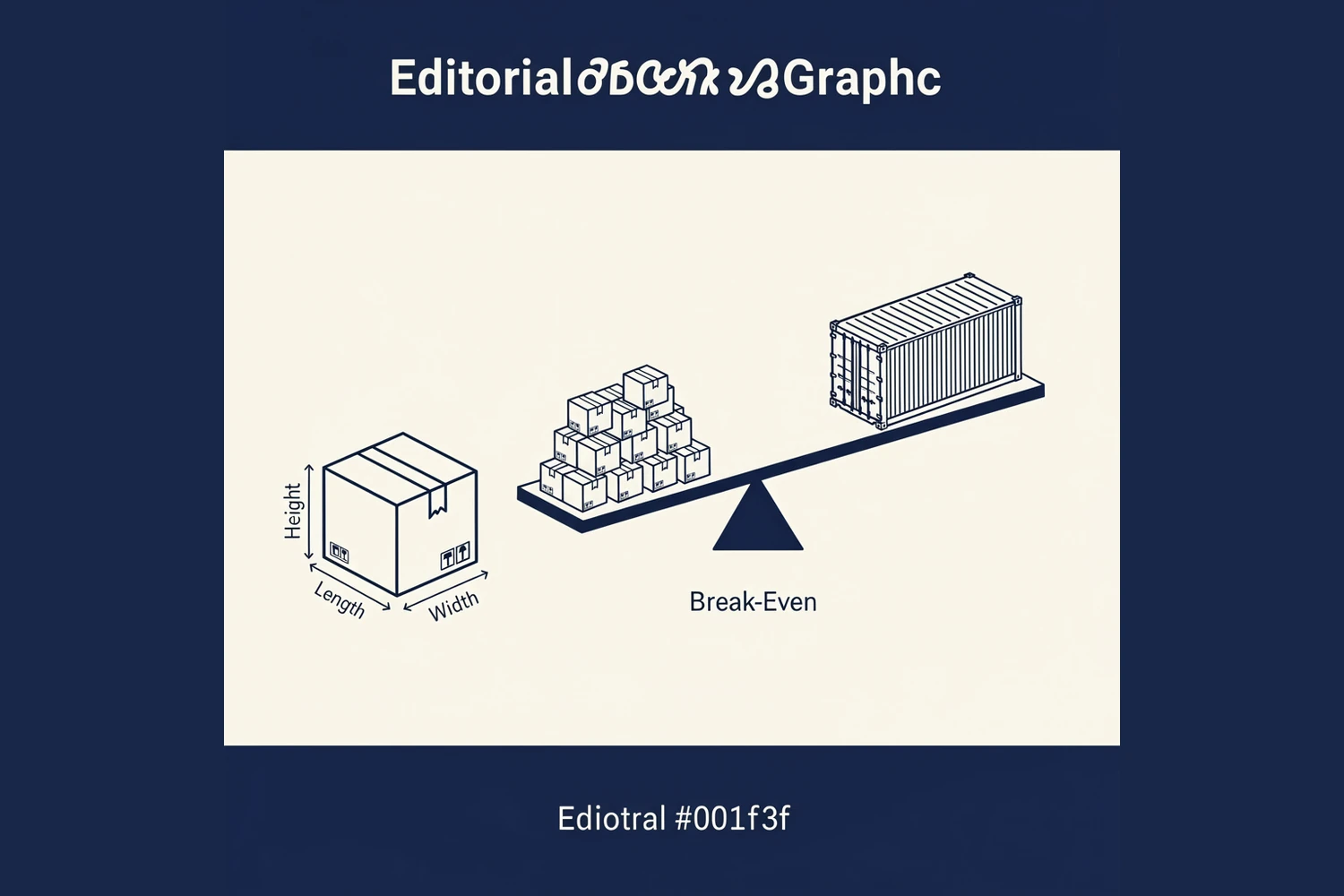
CBM is the volume unit that consolidated ocean freight is priced in, and 1 CBM equals 35.3 cubic feet. Multiply length by width by height in meters for one piece, multiply by the number of pieces, and the result is cubic meters; from centimeters, divide the product by 1,000,000. One CBM equals 35.3 cubic feet — a conversion only 3 of the 299 pages SeaRates measured on 07/26/2026 actually print, and that 9 imply by giving both units somewhere on the page.
Chargeable volume is not always the volume you measured, because consolidated freight bills on the weight-or-measure rule. Under W/M, one CBM counts as one metric ton — 1,000 kg, or 2,205 lbs — and the carrier charges on whichever is greater. Dense cargo pays by weight, light cargo by volume, and 53 pages in the corpus mention chargeable weight or the W/M rule without stating the equivalence that makes it computable.
Less than container load is what LCL means on a freight quote, and the disambiguation is worth stating because search engines currently get it wrong. "How is LCL calculated?" is the most frequent People Also Ask question in this cluster, appearing in 10 of the 89 US search results SeaRates captured on 07/26/2026 — and the answer Google returns opens with meteorology, explaining the lifted condensation level and the rule of subtracting the dew point and dividing by 4.4 °C. LCL on an ocean quote is a volume, not an altitude.
The switch from consolidated ocean freight to a full container is a break-even calculation rather than a rule of thumb. Eight pages in the corpus name a threshold: seven put it at 12 to 15 CBM (424 to 530 cubic feet), and three name 25 to 30 CBM instead or in addition, all three computing it from a named lane's rates. The break-even is total FCL all-in cost divided by the LCL all-in rate per CBM, so it moves whenever either side moves. SeaRates publishes no LCL rate per CBM here: the sources we hold disagree by a factor of two — $40–$75 against $75–$155 for the same trade — and a figure that unstable belongs in a live quote.
| Step | What you do | Worked example |
|---|---|---|
| 1. Volume of one piece | Length x width x height, in metres | 1.2 x 0.8 x 1.0 = 0.96 CBM |
| 2. Total volume | Multiply by the piece count | 0.96 x 10 = 9.6 CBM |
| Working from centimetres | Divide the product by 1,000,000 | 120 x 80 x 100 = 960,000 -> 0.96 |
| 3. Chargeable unit | The greater of CBM and metric tonnes | 9.6 CBM against 7.2 t -> bills on 9.6 |
| Conversion | 1 CBM = 35.3 cubic feet | printed by 3 of 299 measured pages |
Under the weight-or-measure rule one CBM counts as one metric tonne — 1,000 kg, or 2,205 lb — and the carrier charges on whichever is greater. Fifty-three pages in the corpus mention chargeable weight without stating the equivalence that makes it computable.
Why the freight invoice comes in higher than the quote
Freight invoices exceed the quotes they came from for 4 repeatable reasons, none of which requires bad faith. Re-measurement is the most common: the quote was priced on your declared dimensions, the consolidator measured the actual cartons, and the chargeable volume or weight went up. Accessorials come second — a residential delivery, a liftgate, a waiting truck. Timing comes third, when a rate increase lands between booking and gate-in. Government charges come fourth, and were never in the quote to begin with.
An all-in quote is a narrower promise than it reads. All-in ordinarily covers the lines the forwarder controls end to end and excludes duty, federal user fees, customs examination, demurrage, detention and storage after free time. Door to door has the same structure: the phrase describes the route, not the completeness of the price. Both are worth converting into a written exclusion list before booking, because neither carries a fixed definition in US ocean freight.
Published figures for how far a freight invoice exceeds its quote are scarce and describe different things. Of the 299 pages SeaRates measured on 07/26/2026, seven discuss the gap at all, and their numbers are not interchangeable: one documents a single ocean import in full — a $2,800 ocean freight quote that finished at $5,075 after $425 of terminal handling, three days of demurrage at $450, a $925 customs inspection and $475 of documentation, an 81% overrun — while another puts a consolidated shipment's invoice at 50–80% above the quoted ocean rate. The remaining figures, 10–20% and 30%, describe domestic trucking. SeaRates publishes no typical overrun percentage, because no source we hold measures one across a sample.
The 81% case is one shipment rather than a market norm, and its structure matters more than its number: demurrage was a pickup problem, terminal handling and documentation were disclosure problems, and only the customs exam was luck. A quote checked against the line list earlier on this page would have surfaced the first three before the container sailed. On the China trade the DDP quote is where that gap usually opens, and who files the entry on a DDP shipment sets out who carries the liability across 31 measured pages.
| # | Reason | What triggers it | Was it in the quote? |
|---|---|---|---|
| 1 | Re-measurement | The consolidator gauges the actual cartons | Priced on your declared figures |
| 2 | Accessorials | Residential delivery, liftgate, waiting truck | No |
| 3 | Timing | A rate increase lands between booking and gate-in | No |
| 4 | Government charges | Duty, federal user fees, examination | Never |
None of the four freight invoice patterns requires bad faith. "All-in" and "door to door" describe the route and the lines the forwarder controls, not the completeness of the price, and neither phrase carries a fixed definition in US ocean freight. Convert both into a written exclusion list before booking. Of the 299 pages measured, 7 discuss this gap at all.
How long a freight quote stays valid and what expires inside it
Freight quotes expire on a date that has nothing to do with when you booked, and ocean spot rates hold for 3 to 14 days. Ocean freight spot rates are valid for a window measured in days, and the two publishers naming a period at all put it at 7–14 days and 3–7 days respectively — 2 of 299 pages SeaRates measured on 07/26/2026, answering a question that Google raised as a People Also Ask item in 6 of the 89 US search results captured the same day. That ratio of 6 askings to 2 answers is the widest question-to-answer gap in this cluster.
The freight quote's rate is what expires, not the booking. A booking confirmation reserves space on a vessel; the rate attaches to the shipment at gate-in, which is why a container that gates in after the validity date is re-rated at the level in force on that day, even though the booking was made earlier. Delays at the origin factory therefore carry a rate risk as well as a schedule risk, and the risk sits with whoever holds the cargo.
Three parts of a freight quote have different lifespans, and reading them as one number is the error. The base ocean rate is the volatile part and the part that expires; terminal handling, documentation and filing fees are effectively fixed for months; federal fees change each October. A freight quote two weeks old is usually still right about everything except the line that matters most.
| Part of the quote | How long it holds | What resets it |
|---|---|---|
| Base ocean rate | 3 to 14 days | The gate-in date, not the booking date |
| Terminal handling, documentation, filing | Effectively months | A carrier tariff revision |
| Federal fees (MPF, HMF) | Until October | The annual CBP adjustment |
A booking reserves vessel space; the freight rate attaches at gate-in. A container gating in after the validity date is re-rated at the level in force that day, so a delay at the origin factory carries a rate risk as well as a schedule risk. Two publishers of 299 name a validity period at all, against 6 of 89 search results raising the question — the widest question-to-answer gap in this cluster.
A demurrage invoice missing a required element carries no obligation to pay
Demurrage and detention invoices are subject to a federal billing rule in force since 05/28/2024 that almost nobody in this market writes about. Under the Federal Maritime Commission's final rule on detention and demurrage billing practices, in full effect since 05/28/2024, an invoice must be issued within 30 calendar days of the last day the charge was incurred, must go to the contracting party or the consignee but not to both at once, and must contain a specified set of identifying information. Failing to include any of the required information eliminates the billed party's obligation to pay that charge.
Recourse against a demurrage invoice is procedural rather than adversarial. A billed party has at least 30 calendar days to request mitigation, refund or waiver, and the billing party must then attempt to resolve the request within 30 calendar days unless both sides agree to longer. Parties holding a non-compliant invoice can raise it with the carrier, request informal assistance from the Commission's consumer affairs office, or file a charge complaint.
Awareness of the demurrage billing rule is close to zero in the pages an importer is likely to read. Of the 299 pages SeaRates measured on 07/26/2026, exactly one mentions the demurrage and detention billing rule — and that one is the Federal Maritime Commission's own site, while 74 explain how expensive demurrage is. Check the freight invoice against the rule before paying it, and check the free-time clock on our who consolidates less-than-container loads into the USA before the container lands.
| What the rule requires | Detail | If it fails |
|---|---|---|
| Issued within 30 calendar days | Counted from the last day the charge was incurred | No obligation to pay |
| Sent to one party | The contracting party or the consignee, not both at once | No obligation to pay |
| Carries the specified identifying information | Set out in the rule itself | No obligation to pay that charge |
| Leaves you a route | At least 30 days to request mitigation, refund or waiver | The billing party must attempt resolution within 30 days |
Of the 299 pages SeaRates measured on 07/26/2026, exactly one mentions this rule — and that one is the Federal Maritime Commission’s own site, while 74 explain how expensive demurrage is.
We measured 299 pages ranking in US search: what they name and what they skip
By SeaRates' own count on 07/26/2026, out of 299 pages that Google United States ranks in the top ten or cites in AI Overviews across 89 queries about the cost of importing a container, 53 use the term landed cost, 26 mention the merchandise processing fee and 21 the harbor maintenance fee. Method: full page text captured alongside the search results, pages under 200 words excluded, 299 of 345 unique pages measured.
| What the page names | Pages | Share |
|---|---|---|
| Detention | 80 | 26.8% |
| Demurrage | 74 | 24.7% |
| CBM | 69 | 23.1% |
| Landed cost | 53 | 17.7% |
| Chargeable weight or the W/M rule | 53 | 17.7% |
| Merchandise processing fee | 26 | 8.7% |
| Harbor maintenance fee | 21 | 7.0% |
| Both federal fees together | 19 | 6.4% |
| CBM together with cubic feet | 9 | 3.0% |
| PierPass or the traffic mitigation fee | 8 | 2.7% |
| A calculation without an email address | 6 | 2.0% |
| The quote validity period in days | 2 | 0.7% |
| The FMC demurrage billing rule | 1 | 0.3% |
| Measured | 299 | 07/26/2026 |
Read those cost breakdown figures as a measure of disclosure, not of competence. A forwarder whose page never mentions the harbor maintenance fee still charges it correctly on the entry; the numbers show which parts of the bill get explained to the person paying it. The pattern is consistent: large, familiar lines get written about, and the lines deciding whether a bill is contestable — the billing rule, the validity window, the unit a drayage rate is quoted in — mostly do not.
Currency of the published customs fee figures is the other half of the same problem. Of the 26 pages naming the merchandise processing fee, nine still print floors and ceilings that CBP replaced on 10/01/2025, against six showing the fiscal 2026 amounts. SeaRates dates every landed cost figure on this page and re-checks the federal ones each October. Which forwarder assembles the quote is measured separately in the forwarder scorecard and how it is built, where 3 of 62 ranking pages publish a method.
What to do with the number you now have
A landed cost estimate becomes useful the moment you use it to interrogate a quote, and the 5 questions below force the excluded lines into view. Send them in writing, before booking, and keep the reply:
- Which freight quote lines are estimates and which are fixed? Terminal handling and documentation should be fixed; duty and any per-day charge cannot be.
- What is your unit for drayage — per move, per hour or per mile? Without the unit, two drayage quotes cannot be ranked.
- Which destination charges are excluded? Ask for the list by name. Chassis, pre-pull, port programs and storage are the usual omissions.
- Through what date is the ocean rate valid, and is it fixed at booking or at gate-in? The answer decides who carries the delay risk.
- Who issues the bill of lading, and who invoices me for demurrage or detention? The answer names the party the FMC billing rule applies to.
Two freight quotes become comparable only after both are normalised to the same basis. Put them side by side on the line list from the table earlier on this page, add the missing lines at the medians SeaRates measured on 07/26/2026 — $398 to $1,060 per container for the six fixed lines — and convert any per-CBM figure at 35.3 cu ft per cubic meter. A cheaper headline rate with three omitted lines routinely finishes above a dearer rate with none once the full landed cost is added up.
Budget demurrage exposure separately from the landed cost estimate. Demurrage, detention and examination are risks to size rather than costs to forecast, and the per-day medians on this page attach a dollar figure to each day of delay you think plausible. An importer who books with a delay budget and a written exclusion list has removed most of what turns a quote into a surprise.
Frequently asked questions
Harbor maintenance is 0.125% of the cargo value declared on the commercial invoice, with no minimum and no maximum, under 19 CFR 24.24. The importer of record pays duty and federal user fees. Which party pays each freight cost line depends on the Incoterm agreed with the supplier, so one shipment can produce very different landed costs for buyer and seller.
Who pays landed costs?
The importer of record pays duty and federal user fees. Which party pays each freight cost line depends on the Incoterm agreed with the supplier, so one shipment can produce very different landed costs for buyer and seller.
How is the harbor maintenance fee calculated?
Harbor maintenance is 0.125% of the cargo value declared on the commercial invoice, with no minimum and no maximum, under 19 CFR 24.24. A $100,000 ocean entry pays $125. CBP does not collect it on cargo arriving by air.
Which charges are not included in an ocean freight rate?
An ocean freight rate covers port-to-port carriage. Duty, federal user fees, customs entry, terminal handling at both ends, drayage, chassis, storage, demurrage and detention normally sit outside it, whether or not the quote says all-in.
How is LCL calculated?
LCL means less than container load, and it is calculated in cubic meters: length x width x height in meters per piece, multiplied by the number of pieces. Carriers then bill on volume or weight, whichever is greater.
How do I calculate chargeable weight for an ocean freight shipment?
Compare the volume in CBM against the gross weight in metric tons. One CBM counts as 1,000 kg (2,205 lbs), and the carrier charges on whichever is higher — the weight-or-measure rule. Consolidators apply a 1 CBM minimum, so 0.4 CBM bills as one.
How long is a freight quote valid?
Ocean spot quotes are usually valid for days rather than weeks; publishers naming a period put it at 3–14 days. The rate attaches at gate-in, so a container that gates in after the validity date is re-rated.
Are freight quotes negotiable?
The forwarder's own lines — documentation, filing, margin — are negotiable, and the base rate is negotiable by volume commitment. Terminal handling, federal fees and duty are not.
What is a terminal handling charge?
Terminal handling covers lifting, moving and gate handling of a container at the port, billed at both origin and destination. Publishers in US search put it at a median $138 to $340 per container.
What is a peak season surcharge?
A peak season surcharge is a temporary addition the carrier applies when demand exceeds capacity, usually in the pre-holiday months. Billed per container or per CBM, it is one of the few surcharges a volume contract can limit.
What is a GRI in shipping?
A general rate increase raises the base ocean rate itself rather than adding a line. Carriers on US trades must file increases with the Federal Maritime Commission 30 days in advance, and they often collect less than announced.
What is the difference between demurrage and detention?
Demurrage runs while your container sits inside the terminal past free time and is billed by the terminal. Detention runs while the carrier's container is outside the terminal in your hands and is billed by the carrier.
Can I refuse to pay a demurrage invoice?
An invoice that omits any element the Federal Maritime Commission requires eliminates the obligation to pay that charge, under the rule in force since 05/28/2024. Request mitigation within your 30-day window, or file a charge complaint with the Commission.
What does a door to door freight quote actually include?
Door to door describes the route, not the completeness of the price. Duty, federal user fees, customs examination and any storage after free time are normally excluded, so ask for the exclusion list in writing.
Is an import cost calculator the same as a quote?
No. A calculator returns an estimate built from published rules and market medians; only a carrier or forwarder can issue a price that binds anyone. Estimates on this page carry the date of the figures behind them.