Ranking8 companies ranked by how often 26 measured queries name them
What the car shipping rankings measure, who they actually name, and what you can check yourself
Car shipping companies rankings in this search result order two different businesses as though they were one, and none of them dates a price. What the sweep of 27 pages found:
- The list mixes brokers with shipowners. 7 pages of the 27 name ocean vessel operators, 10 pages name US auto transport brokers, and exactly one page names both.
- Visibility is what the market's ordering measures. Roadrunner Auto Transport is named in 14 of the 26 measured queries, Wallenius Wilhelmsen in 8, Höegh Autoliners and SGT Auto Transport in 6 each.
- Prices are quoted and never dated. 15 pages of the 27 name a dollar figure, 0 pages say when it was true, and 0 pages use the word median.
- The scores rest on review platforms. 12 pages of the 27 rank on platform reviews, and one of those twelve says how it weighs them.
- Almost nobody explains who is liable. 4 pages of the 27 explain the difference between a broker and the carrier that signs the bill of lading.
- Nobody sends you to the register. 3 pages of the 27 check a company against a registry and none links to the FMC list, which held 3,273 records for licensed ocean freight forwarders and 9,030 records for NVOCCs when SeaRates read it on 07/26/2026.
- SeaRates publishes no score for any car shipping company here, because a score needs a rate series and a complaint record with a denominator, and neither exists yet.
Car shipping companies ranked by how often the market names them
Two different businesses share one search result: US auto transport brokers and the lines that own the ships. Among the car shipping companies named here, Roadrunner Auto Transport appears in 14 of the 26 queries SeaRates measured, Wallenius Wilhelmsen in 8, Höegh Autoliners and SGT Auto Transport in 6 each — and the first two are not competitors in any meaningful sense.
| # | Company | Named in | Role | What is verifiable about it |
|---|---|---|---|---|
| 1 | Roadrunner Auto Transport | 14 of 26 queries | US broker | FMCSA authority, complaint record |
| 2 | Wallenius Wilhelmsen | 8 of 26 queries | Vessel operator | Fleet, sailing schedule, port calls |
| 3 | Höegh Autoliners | 6 of 26 queries | Vessel operator | Fleet, sailing schedule |
| 4 | SGT Auto Transport | 6 of 26 queries | US broker | FMCSA authority |
| 5 | Easy Auto Ship | 6 of 26 queries | US broker | FMCSA authority |
| 6 | Grimaldi Group | 5 of 26 queries | Vessel operator | Fleet, Atlantic and West Africa services |
| 7 | Schumacher Cargo Logistics | 5 of 26 queries | Forwarder / NVOCC | FMC licence status |
| 8 | Sherpa Auto Transport | 5 of 26 queries | US broker, ships via AES | FMCSA authority, partner's FMC status |
The car shipping companies table above is a ranking, and it is worth being exact about which one. It ranks visibility in the US search result — how many of the 26 measured queries named each company on 07/25-26/2026 — and it ranks nothing else. A company sits high because it advertises widely and because other lists already named it, which is a different property from being the right choice for one vehicle on one route. The rank column counts mentions and says so; the role column beside it is the part that decides who you are actually dealing with, and the last column is what you can check before a deposit.
Seven of the 27 pages name ocean vessel operators; ten name US auto transport brokers; exactly one car shipping page names both. Readers therefore meet a list of "companies" mixing the firm taking their deposit with the firm whose ship carries the car, and almost nobody separates the two roles or their liability.
What those lists are built on
International car shipping companies rankings in this result set are built on BBB profiles, Trustpilot scores, Yelp entries and Google stars, aggregated without a published weighting: twelve of 27 pages rank on platform reviews, and one of the twelve says how it weighs them.
| Basis | What it answers | What it does not answer |
|---|---|---|
| Platform review average | How the company communicates with customers | Whether the ocean leg was performed |
| Number of reviews | How much retail traffic the company handles | Anything about shipment volume |
| Editorial score | The editor's judgement, if the method is published | Whether the score is reproducible |
| Licence status | Whether the firm may legally arrange the ocean leg | Service quality |
Four car shipping companies pages of 27 show a score, two publish a method, and one does both. Two report a sample size, and both sampled companies rather than shipments — 30-plus car shippers against 70 metrics in one case, 31 companies and 67 metrics in the other.
A review score measures the customer's dealings with an auto transport broker, not the performance of the ocean leg. The complaint most often behind a one-star review is a pickup date missed by a truck, which is real but says nothing about whether the vessel booking existed.
Broker, forwarder, NVOCC or vessel line: who owes you what
Car shipping companies stand in four legally different positions, and 4 of 27 pages explain the difference between a broker and the carrier that signs the bill of lading. Car shipping companies advertise the same service and stand in four legally different positions, and the position decides who answers when the car is damaged, delayed or held.
| Role | Licensed by | Issues a bill of lading | You can hold it liable as |
|---|---|---|---|
| Auto transport broker | FMCSA for the US road leg | No | Your agent for trucking |
| Ocean freight forwarder | FMC | No | Your agent |
| NVOCC | FMC | Yes, its own house B/L | A carrier |
| Vessel operator | Flag state and trade regulators | Yes, the master B/L | The carrier of record |
An auto transport broker arranges the move and subcontracts it to a carrier, and its FMCSA authority covers the US road leg only. An NVOCC issues its own bill of lading and takes carrier liability with it. An ocean freight forwarder books space in your name without issuing a document of its own.
The $75,000 NVOCC bond is a shared pool across all claimants, not insurance on one car. Where the method of shipment matters to the choice — a running car on a RoRo deck against a project car in a container — the decision belongs upstream, in whether the car travels RoRo or in a container.
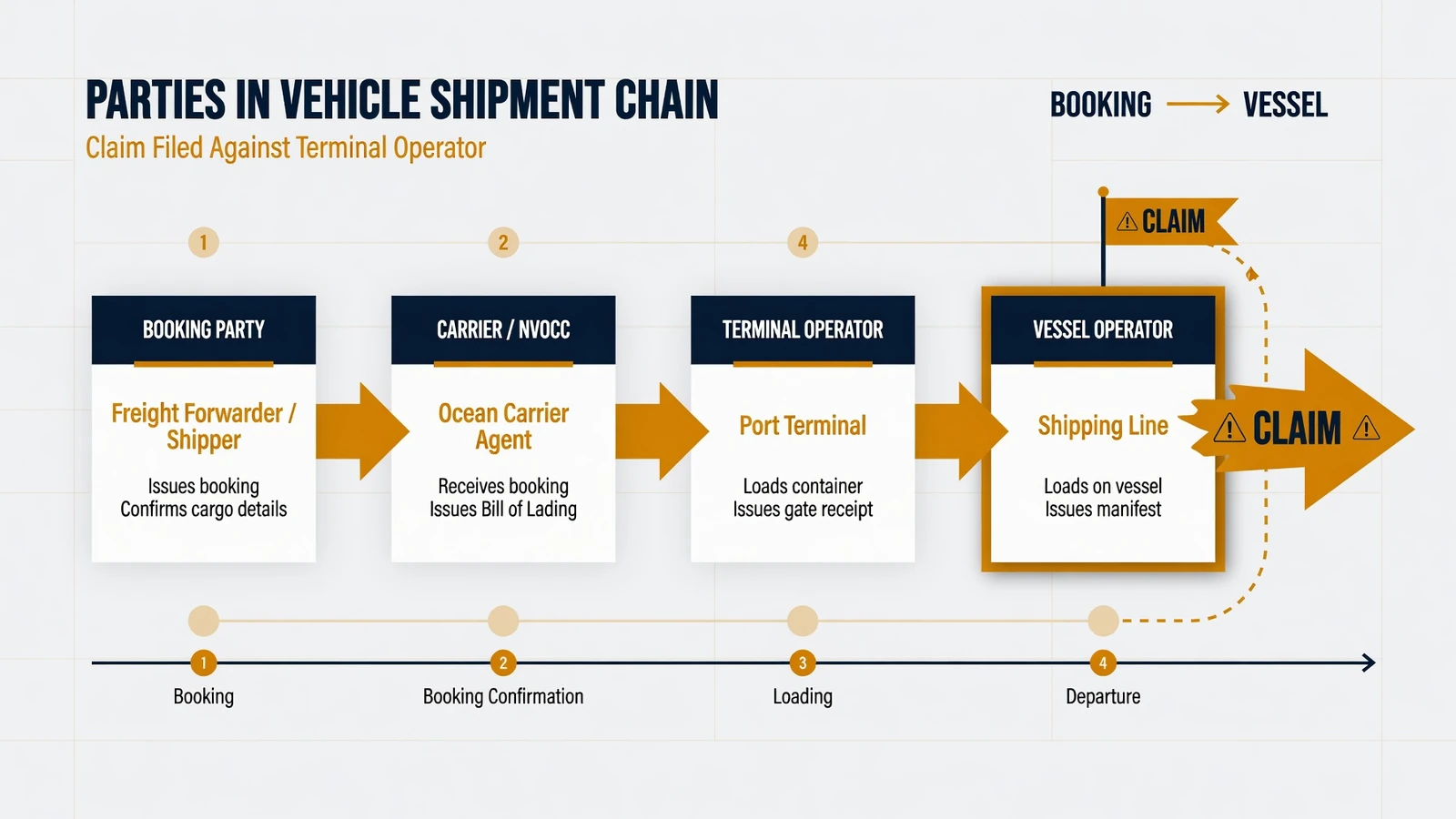
Where the deal breaks: deposit, resold booking, disputed damage
Ten of 27 pages discuss deposits and upfront payment, and three publish any complaint data at all. Car shipping companies rarely fail spectacularly; the ordinary failures are three, and each is visible before the money moves.
- The resold booking. An auto transport broker takes the deposit and passes the job to a company you never chose. The second firm has no relationship with you and no reason to honour the first one's promises.
- The deposit outliving the service. A large non-refundable deposit taken before a vessel is booked is a signal, not a formality: ask which sailing the booking is against and what happens to the money if it does not exist.
- The disputed damage. Photographs at drop-off and the terminal's own condition report are the only records an insurer compares against arrival. Without them, damage is undated and undated damage is nobody's.
A complaint count means nothing without the number of shipments behind it. Two complaints across four hundred moves and two across nine are not comparable, so no complaint league table appears here: SeaRates has no denominator for any company, and neither does any page in the corpus. Costs that arrive after the quote — duty, port charges, clearance — are set out in the full landed cost breakdown, duty included.
The three patterns above have four free federal checks against them, and the order they run in matters: how not to get scammed shipping a car takes about nine minutes end to end.
Car shipping companies are searched for beside the words scams, ratings, most reliable and to avoid, and those four words want three different things. Two of the three patterns above are contract design rather than fraud — a broker reselling a booking it never owned, and a deposit taken before a sailing exists — while the third, damage nobody will date, is a records problem. Outright fraud is the rarest of them and the easiest to screen for, because it fails the first of the three checks below: a company that will not name the legal person issuing the bill of lading has already answered the question.
Ratings in the sense the query means do not exist for this market. 12 pages of the 27 rank on platform reviews and one of those twelve says how it weighs them, and a review score measures a customer's dealings with a road broker rather than the performance of the ocean leg. A most-reliable ordering would need a complaint record with a shipment denominator behind it, which no page in this corpus holds and neither does SeaRates. What exists instead is the licence, the role and the document — checkable in about five minutes, and none of the three is an opinion.
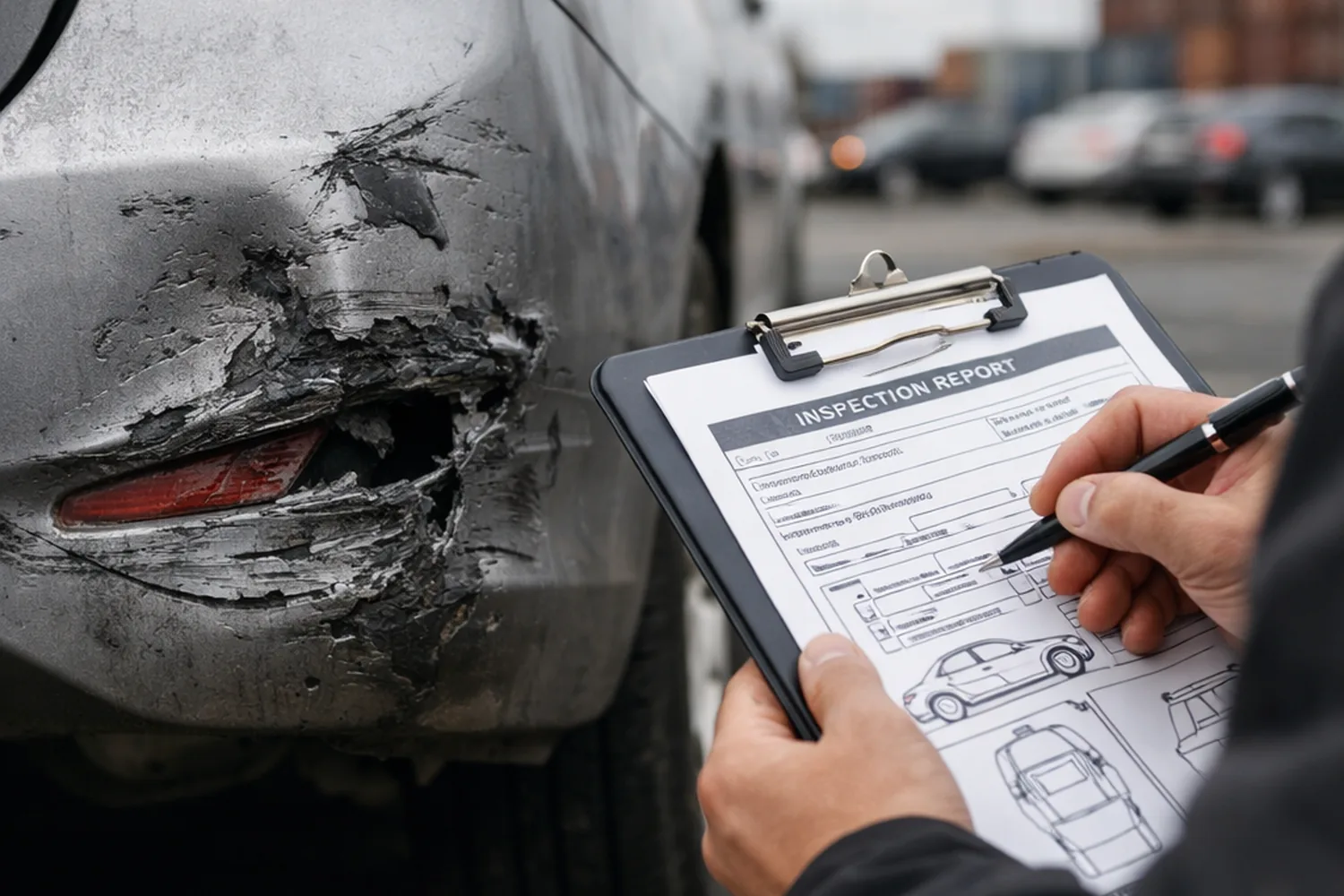
Three things you can check before paying a deposit
Three of 27 pages check a company against a registry, and none links to the FMC list. Car shipping companies can be screened in about five minutes with three questions, none of which requires a ranking.
- Which legal entity issues the bill of lading? Car shipping companies trade under names, and a name is not a licence. The entity on the document is the one a claim goes to, and it is often not the brand on the website.
- Does that entity appear in the FMC registry? The registry held 3,273 licensed ocean freight forwarder records and 9,030 NVOCC records when SeaRates read it on 07/26/2026; the NVOCC list mixes licensed operators with registered foreign ones, so read the licence column rather than the row count. The step-by-step version is on which credential covers the ocean leg.
- Can the company explain the export filing? Census requires EEI through AES 72 hours before export for every used self-propelled vehicle regardless of destination or value. The ITN comes back per VIN and can be requested. A company unable to explain the filing is unlikely to be doing it.
Country-specific admission rules — age limits, drive side, duty — sit outside these rankings, and the corridor pages that would carry them are not published yet. The US-side export duties that apply whatever the destination are set out under the two 72-hour filings and what each one wants.
Car shipping companies named in the ordering above, run through step two on 07/28/2026:
| Company, as the corpus names it | Named in | What the FMC register actually shows |
|---|---|---|
| Schumacher Cargo Logistics | 5 of 26 queries | Licensed NVOCC, OTI licence 020417, $75,000 bond with Merchants National Bonding since 22.09.2025, licence due for renewal 31.07.2029 |
| Roadrunner Auto Transport | 14 of 26 queries | One Roadrunner entity holds an OTI licence: ROADRUNNER HOLDINGS, L.L.C., licence 020882, an ocean freight forwarder in Houston trading as Roadrunner Moving & Storage and Roadrunner, Ltd. The register does not tie that licence to the auto transport brand, and neither does SeaRates |
| Wallenius Wilhelmsen, Höegh Autoliners, Grimaldi Group | 8, 6 and 5 of 26 | Vessel operators. The OTI register does not cover shipowners, so absence from it is not a finding about them |
| SGT Auto Transport, Easy Auto Ship, Sherpa Auto Transport | 6, 6 and 5 of 26 | None of the three appears in either federal list under that name, checked 07/28/2026. The only SGT in the register is a Shanghai company. Road brokers are licensed by FMCSA, not the FMC, so this is a finding only if they arrange the ocean leg themselves |
The Roadrunner row is the whole argument of this page in one line. The most-named brand in the search result cannot be matched to a licence by its brand name alone, and the entity that does hold the nearest licence trades under two other names entirely. That is not an accusation of anything — it is what happens when a list ranks names and a register lists entities.

What we measured in this search result
International car shipping companies rankings quote prices freely and date none of them: 15 of these 27 pages name a dollar figure, and not one says when it was true. SeaRates read the full text of every page ranking in Google US for these 26 queries on 07/26/2026 and counted what each discloses.
| What the page does | Pages | Share |
|---|---|---|
| Names companies individually | 25 | 92.6% |
| Quotes a dollar figure | 15 | 55.6% |
| Dates that figure | 0 | 0.0% |
| Uses the word median | 0 | 0.0% |
| Mentions USDOT or FMCSA | 10 | 37.0% |
| Mentions FMC or OTI | 4 | 14.8% |
| Names no regulator at all | 14 | 51.9% |
| Links to the FMC registry | 0 | 0.0% |
Two machine matches for a dated price in these rankings were read individually and rejected: one was a company's founding year, the other a publication date in a blog listing. Car shipping prices in this corpus are therefore entirely undated.
USDOT or FMCSA appears on 10 pages against 4 naming FMC, which is the pattern the brief predicted for this segment and the opposite of what the destination-country pages show. A missing mention is not a missing licence — the sweep counts what pages say, not what companies hold.
What this ordering does not measure, and the two rows that would fix it
Ranking by mentions is a real measurement of a real thing, and it is not the measurement a buyer wants. The ordering a buyer wants runs on four rows: licence status, role in the deal, a rate series and a complaint record with a denominator. Car shipping companies can be compared on all four, and SeaRates currently holds neither of the last two — which is why the list above is labelled by what it counts rather than dressed up as a verdict.
| What a ranking would need | How it is measured | Who can confirm it | Can you check it today? |
|---|---|---|---|
| Licence status | Entity present in the FMC OTI list | Federal registry | Yes — free, and this page shows how |
| Role in the deal | Who issues the bill of lading | The document itself | Yes — ask before you sign |
| Rate spread | Quotes for identical shipments | Our own quote array | No — nobody publishes this, us included |
| Complaint rate | Complaints divided by shipments | Regulator and company data | No — no denominator is published |
SeaRates has now checked two of the eight named car shipping companies against the registry and published both results above; the remaining six are the next data step rather than a limitation of principle, because the registry is open and the sweep found 0 of 27 pages linking to it. Two of the four rows above are therefore already available to any reader, and two need data this project does not hold. SeaRates has no quote array for vehicles either, so no median rate appears on this page — published vendor bands run $900-2,500 for RoRo and $3,000-5,500 for a sole-use container as read on 07/25-26/2026, and they are ranges, not medians. Company profiles are not published yet. Until they are, the licence and bond behind any name on this page can be read straight from the federal register, and running that check yourself takes about two minutes.
How we make money
Five car shipping companies pages of 27 in this result set say who pays for them. SeaRates is paid nothing by any company in this list — no page here carries a referral link — and rank is never sold: a company cannot buy a position, a badge, or the removal of a negative finding.
Disclosure sits at 18.5% in this corpus, which is higher than in the forwarder rankings and still low for pages recommending where to send a car and several thousand dollars. When a ranking does appear here, the fee column will appear beside it.
Sources
- SeaRates measurement of 27 pages across 26 cluster queries, 07/26/2026. Full-text sweep, 120-word minimum; each price-date match was read individually and both machine matches were rejected.
- Company naming frequencies from the highlights of 26 captured search results and the headers of 50 AI answers, read 07/25-26/2026.
- Federal Maritime Commission, OTI search application — 3,273 licensed ocean freight forwarder records and 9,030 NVOCC records. Read 07/26/2026.
- U.S. Customs and Border Protection, Exporting Used Self-Propelled Vehicles — EEI through AES 72 hours before export regardless of destination, value or condition. Read 07/26/2026.
- Published vendor bands for RoRo and container shipment of one vehicle, collected from the AI answers for the car shipping cluster. Read 07/25-26/2026.
Corrections to any figure on this page: [email protected].
Frequently asked questions
Ask which legal entity issues the bill of lading, check that entity in the FMC registry, and ask the company to explain the 72-hour export filing. A firm answering all three clearly is not a scam; a firm unable to answer the first is not yet a counterparty. No page in this search result answers that verifiably, and neither does this one.
How do I not get scammed shipping my car?
Ask which legal entity issues the bill of lading, check that entity in the FMC registry, and ask the company to explain the 72-hour export filing. A firm answering all three clearly is not a scam; a firm unable to answer the first is not yet a counterparty.
What is the most reputable car shipping company?
No page in this search result answers that verifiably, and neither does this one. Reputation here is measured by review platforms, which record how a broker communicates rather than whether the ocean leg was performed. Compare licence status, role and quote completeness instead.
How to tell if a car shipping company is legit?
Three checks: the entity on the bill of lading, its presence in the FMC OTI registry, and its account of the AES filing. A USDOT number covers US trucking only and does not answer the ocean question.
Can you negotiate with car shipping companies?
With a broker, often — the margin is theirs to move. With a vessel operator, rarely, because the tariff is filed. What is always negotiable is the scope: which charges are included, who pays destination handling, and when the deposit becomes non-refundable.
Do cars get damaged during shipping?
Some do. What decides a claim is documentation: photographs at drop-off, the terminal condition report, and the arrival survey. Damage recorded at both ends is payable; damage that appears only at delivery rarely is.
Which is better, Sherpa or Montway?
Both are US brokers, which means the comparison is between two intermediaries rather than between two carriers. Ask each which ocean partner they book through, whether that partner holds an FMC licence, and who signs the bill of lading.