GuideMethods, published bands and what the quote leaves out
How car shipping out of the USA works, what sets the bill, and why nothing sails inside 72 hours
Four methods, one federal clock, and a destination country that moves the bill more than the method does. What the published numbers say, and what SeaRates will and will not stand behind:
- RoRo is published from $900, a sole-use container from $3,000. The published span runs 6.1 times from the RoRo floor to the sole-use ceiling for one and the same service.
- Nothing sails inside 72 hours. The export filing sets the earliest legal sailing date, and the vessel schedule only adds to that floor.
- The destination decides more than the method. Of the 18 pages that quote a price, 12 never name a destination country at all.
- What may travel inside the car depends entirely on the box. RoRo forbids personal items; a container permits declared household goods. It is the second most discussed topic in this search result, raised by 27 of 47 pages.
- The far side is not in the ocean quote. Terminal handling, documents and the local agent are published at $500 to $1,500 per car, and import duty sits outside even that.
- No median rate and no transit promise appear on this page, because both need a quote array this project has not collected.
The four ways international car shipping crosses an ocean
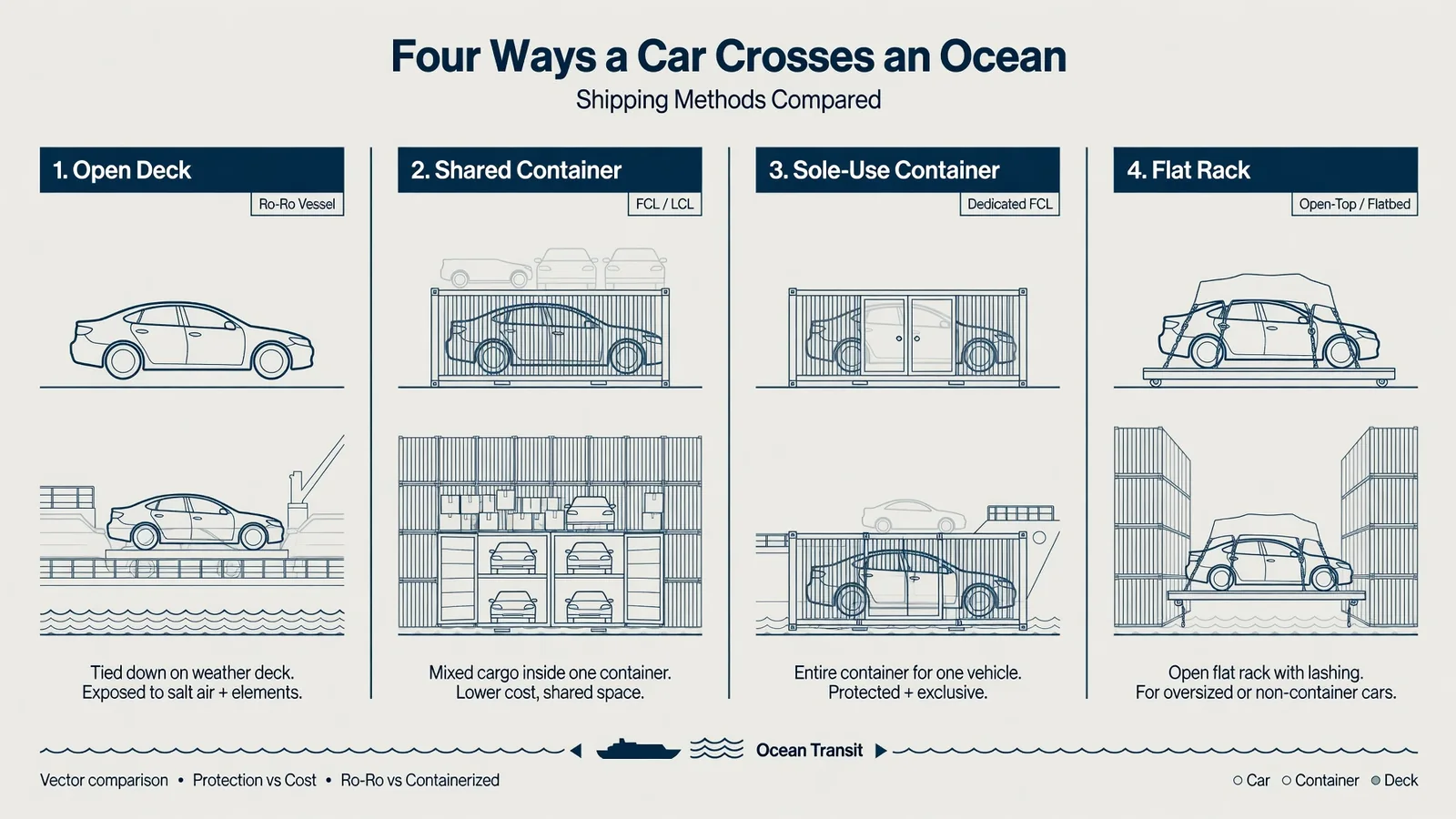
RoRo is published from $900, a sole-use container from $3,000, and the gap between them buys space for belongings. Four methods carry a car across an ocean, and the choice is made for you more often than not: a car that does not run cannot use the cheapest of them, and a car with household goods inside cannot use it either.
| Method | Published band per car | What may travel inside | Which cars are accepted |
|---|---|---|---|
| RoRo (roll-on/roll-off) | $900-2,500 | Nothing beyond factory equipment | Running, driveable, under a quarter tank |
| Shared container | $1,500-3,000 | Limited, declared goods | Any, including non-running |
| Sole-use container (20ft/40ft) | $3,000-5,500+ | Household goods packed around the car | Any, including classics and projects |
| Air freight | $5,000-50,000 | Minimal | Any, subject to airline acceptance |
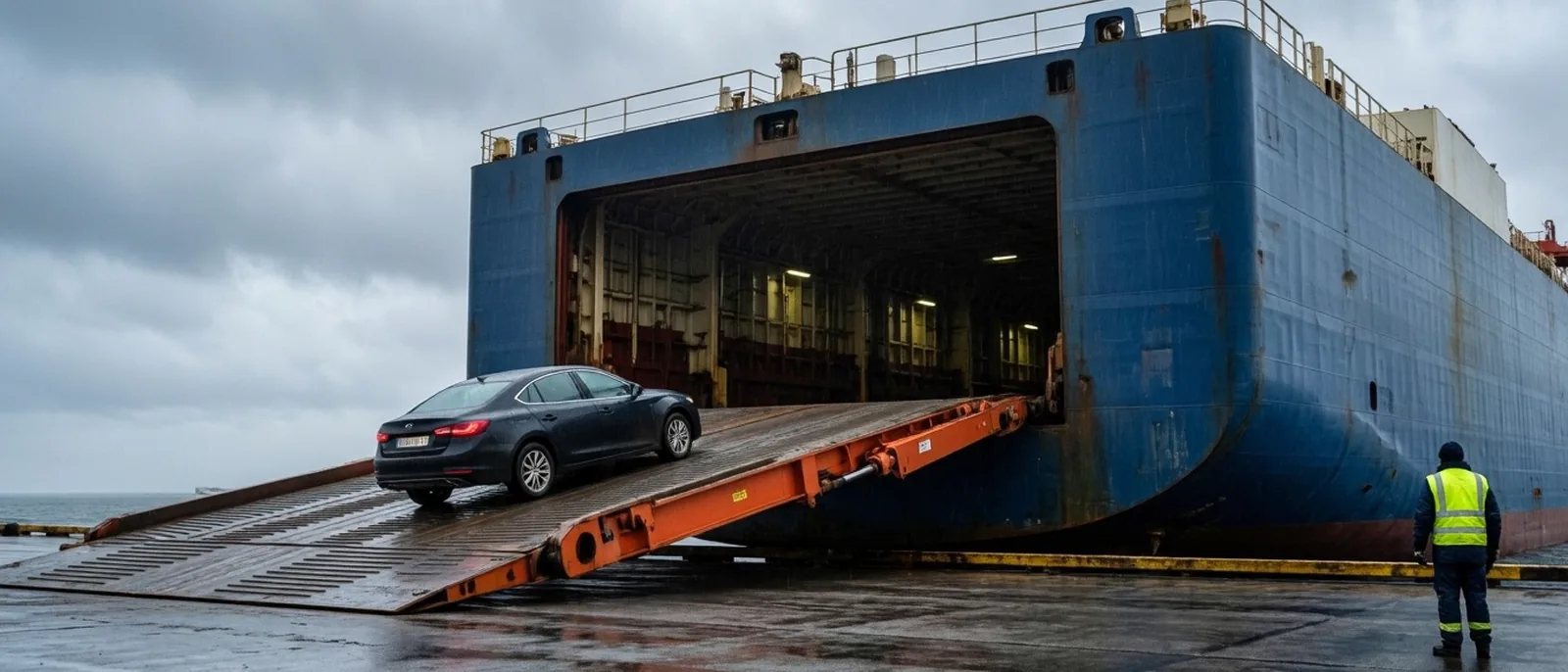
Roll-on/roll-off works the way its name says: the car is driven up a ramp onto a vessel deck built for wheels, lashed down and driven off at the other end. RoRo sailings are frequent on established trades, loading is quick, and the price reflects that the car occupies deck space rather than a box.
Container shipping puts the same car inside a steel box, either alone or with two to four other vehicles sharing the space. A shared container splits the cost of the box across those cars and adds waiting time, because the container leaves when it is full or when the consolidator decides it leaves. A sole-use container leaves when you say so and takes whatever legally fits around the vehicle.
Vendor bands for a container or a RoRo booking are published ranges, not paid medians. Every figure in the table above comes from vendor pages that ranked for these queries when SeaRates read them on 07/26/2026, and not one of those pages states which shipments its range describes. Treat the table as the shape of the market, then get a written quote for your car and your ports. The published span runs 6.1 times from the RoRo floor to the sole-use ceiling for one and the same service, and 27 of 47 pages in this corpus compare the methods without dating a single band.
The published bands behind that table, and what sits outside every one of them, are broken down in what RoRo shipping actually costs and what the band leaves out.
What actually sets the number on the quote
Make, model and year set the base rate; size, drive side and whether the car runs move it from there. Vehicle shipping is priced on the space a car occupies and the trouble it creates, which is why a quote form asks for the VIN before it asks for anything else.
These six inputs do most of the work, roughly in this order of influence:
- Dimensions and weight. A pickup or a three-row SUV displaces more deck or container volume than a sedan, and the rate follows volume rather than value.
- Running condition. A car that does not start needs winching, which removes RoRo from the options and pushes the shipment into a container.
- Departure port. East Coast, Gulf and West Coast rates for the same destination are published separately by the same vendors, and the difference runs into hundreds of dollars.
- Inland move to the terminal. Trucking the car to the port is a separate service, priced by distance, and it is the line most often missing from a headline figure.
- Drive side and modifications. Right-hand drive, lifts, roof racks and non-standard bodywork change both handling and destination admissibility.
- Season. Vessel space tightens in summer and around holiday peaks on the trades that also carry consumer cargo.
Three sources in one search result give upper bounds of $4,000, $5,000 and "above $5,000" for the same car, with lower bounds running from $700 to $1,500. Those lower bounds differ by 2.1 times between publishers, while the RoRo and shared-container floors inside a single source differ by about 1.7 times. Disagreement between publishers is therefore larger than the difference between two methods, which tells you what those averages are worth as a planning number.
Vehicle attributes are named as price drivers on 8 of the 47 pages SeaRates measured, and the departure port on 12; an online calculator uses exactly those inputs and little else. Without a VIN, a destination and a departure port it cannot produce a rate, so what it returns is an estimate shaped like a price. Reading it as a quote is the single most common way a car shipping budget goes wrong.
The destination country moves the bill more than the method does
International car shipping quotes drift by hundreds of dollars between methods and by thousands between countries, and the second number is the one that decides whether the move is worth making. Twelve of the 18 pages that quote a price never name a destination country at all.
These four things change the moment a destination is named:
- Import duty and taxes. Charged on a customs value the destination country sets, not on what you paid.
- Age and emissions limits. Some countries refuse vehicles above a stated model age outright; others tax them heavily.
- Drive-side rules. Left-hand-drive cars are barred from some markets and right-hand-drive from others.
- Service availability. Not every port has RoRo calls, and where it does not, the container price is the price.
Only 10 of 47 pages in this corpus tie price to the destination country in any way. The rest publish a national average for a service whose cost is set abroad, which is how a reader ends up with a number that cannot be wrong because it was never about anywhere.
Destination-side charges — terminal handling, documentation and the local agent — are published at $500 to $1,500 on top of the ocean freight, and duty sits outside even that. Country-level admissibility rules, duty and port charges belong on corridor pages SeaRates has not published yet, and saying otherwise would point you at a page that does not exist. What the destination adds on top of the ocean rate is itemised line by line under duty, port charges and the rest of the delivered total.
What may travel inside the car, and on which method
A RoRo booking wants the car empty, running, and under a quarter tank of fuel. Personal items inside a vehicle are the second most discussed topic in this whole search result — 27 of 47 pages raise it, level with the method comparison itself — and the answer depends entirely on the box the car travels in.
RoRo forbids personal items inside the car. Four independent sources in this corpus give the same reason: port and safety rules govern what sits on a vehicle deck, terminals inspect at drop-off, and a car found loaded is refused or emptied at the owner's cost. Factory equipment stays; a spare tyre and a jack stay; everything else comes out.
Container shipping permits household goods packed around the vehicle, with the shared option restricting more than the sole-use one, because other people's cars share the space and the consolidator carries the liability. Goods that travel inside a container must appear in the export filing and in the destination customs declaration — undeclared contents are a customs problem, not a packing one, and the penalty lands on the shipper rather than on the carrier.
Two practical consequences follow for a household moving a car. A household relocating with a car often pays less for one sole-use container carrying both than for a RoRo booking plus a separate shipment of boxes. And an owner who plans to fill the trunk should say so before the quote, not after, because the answer changes the method and the method changes the price.
Shipments of belongings without a vehicle run on their own routes and their own rates. Barrel and balikbayan-box corridors are not published here yet; the closest measured guide is how a household shipment is priced by volume rather than weight.
The same rule set, read as a matrix rather than as three paragraphs:
| Method | Personal items inside | What governs it | Where the contents must be declared |
|---|---|---|---|
| RoRo | Not permitted beyond factory equipment, spare tyre and jack | Vehicle-deck safety and port rules; terminals inspect at drop-off and a loaded car is refused or emptied at the owner's cost | — |
| Shared container | Limited, and declared | Other owners' cars share the box and the consolidator carries the liability | Export filing and destination customs declaration |
| Sole-use container | Household goods packed around the car | The box is yours for the voyage | Export filing and destination customs declaration |
Undeclared contents are a customs problem rather than a packing one, and the penalty lands on the shipper, not on the carrier.
Marine cover, and the General Average bill nobody expects
International car shipping prices cover separately from freight, as a percentage of what you declare the car is worth: all-risk runs about 1.75% of declared value, and General Average can bill an undamaged car. The three products sold under the insurance heading differ enormously in what they actually do.
| Cover | Typical rate | What it pays for | Common exclusions |
|---|---|---|---|
| All-risk | ~1.75% of declared value | Physical damage, theft, fire, total loss | Pre-existing damage, mechanical failure, personal items |
| Total loss only | ~1.25% of declared value | Only the complete loss of the shipment | Every partial damage claim |
| General Average | Not a product you buy | Your share of a joint sacrifice | — |
A deductible around $500 is standard on all-risk cover for a shipped vehicle, and one source in this corpus gives a wider band of 1.5% to 2.5%. Declared value is what the payout is calculated against, so a car declared below market to save premium is a car underpaid after a loss.
General Average spreads one casualty across every cargo owner aboard. When a ship is grounded, catches fire or jettisons cargo to survive, maritime law lets the carrier declare General Average and require every shipper on that voyage to contribute proportionally to the loss — including the owner of an untouched car in a container three decks down. Release of the cargo can be conditioned on a bond or a cash deposit against that contribution, and the case can take years to settle.
Marine cover for a shipped car is mentioned by 14 of 47 pages in this corpus, and 5 name a rate as a percentage. General Average appears in two of the AI answers generated for these queries and almost nowhere in the organic results, which is a strange gap for the one mechanism that can produce a bill without anything happening to your car.
How a vehicle booking runs from deposit to release
Seven steps carry a car from a deposit to a release order, and two of them belong to the government rather than to the shipper. Vehicle shipping looks like a single transaction from the outside and is a chain of handoffs from the inside, each with a different party holding the car.
- Quote and booking. The vehicle is described, ports are fixed, a sailing is reserved and a deposit is taken.
- Documents to the agent. Title, identification and, where a lien exists, the lienholder's written release.
- Export filing. EEI goes into AES and returns an ITN; this is a federal step with its own clock.
- Presentation to CBP. Documents and, for a sea export, the car itself are presented at the port of exportation.
- Drop-off and condition report. The terminal inspects the car and records damage; that record is the baseline for any later claim.
- Loading and bill of lading. The car sails; the bill of lading is issued to the named consignee.
- Arrival, clearance and release. Destination customs clears the car and the terminal releases it against the original document.
The condition report at step five deserves more attention than it usually gets, because a car arrives with no other record of how it looked at drop-off. Photographs taken at drop-off, with the terminal's own inspection sheet countersigned, are what an insurer compares against the arrival survey. Cars arrive with damage that nobody can date, and undated damage is damage nobody pays for.
The bill of lading is named on 11 of 47 pages in this corpus, and the two federal steps on 5. A bill of lading releases the car at destination to the consignee named on it, not to whoever paid for the booking. Naming a relative, a broker or a clearing agent as consignee for convenience is a decision that transfers control of the vehicle, and reversing it after issue is slow.
How long it takes, and why nothing sails inside 72 hours
Ten of 47 pages quote a vehicle transit time in days, and none says where the number came from. The floor under every schedule is regulatory rather than nautical: the 72-hour filing sets the earliest legal sailing, and vessel schedules add to that floor without ever subtracting from it.
A realistic timeline for a car stacks four intervals. Paperwork collection takes as long as the slowest third party — a lienholder release can take a week. The 72-hour federal window starts only when the filing is complete and the car is available for presentation. Sailing frequency then decides how long the car waits at the terminal, and that varies from a few days on a busy Atlantic trade to a month on a thin one. Ocean transit and destination clearance close the chain.
SeaRates has not measured a median transit for vehicle corridors, so no transit promise is repeated on this page. Vendors publish confident day counts for routes they serve, and those counts may well be accurate; without a sample and a date attached, there is no way for a reader to tell an operating average from a marketing one.
Booking a vehicle around the constraint is straightforward once the constraint is visible. File early rather than fast, treat the sailing date as the output of the paperwork rather than the input to it, and ask which specific vessel and voyage the booking is against — a booking without a vessel name is a place in a queue.
The same four intervals, and what each one actually depends on:
| Interval | What sets its length | What SeaRates can say about it |
|---|---|---|
| Paperwork collection | The slowest third party in the chain; a lienholder release can take a week | Not predictable in advance, and not a shipping variable |
| The 72-hour federal window | Starts only when the filing is complete and the car is available for presentation | A floor under the schedule, never a ceiling |
| Wait for a sailing | Sailing frequency on that trade — a few days on a busy Atlantic route, up to a month on a thin one | Varies by corridor; no corridor sample published here |
| Ocean transit and destination clearance | The corridor itself and the destination customs queue | 10 of 47 pages quote a day count and none says where it came from |
The table deliberately carries no day counts of its own. A transit figure without a sample and a date behind it is a marketing number, and this page does not have the sample.
What the quote leaves for the far side
Terminal handling, documents and the local agent are published at $500 to $1,500 per car, and duty is separate from all of it. The ocean quote stops at the destination port, and everything that happens after the ship ties up is billed by parties who never spoke to you.
| Line | In the ocean quote? | Who bills it |
|---|---|---|
| Inland move to the US port | Sometimes, as a separate line | Your forwarder or trucker |
| Export filing and documentation | Usually | Your forwarder |
| Ocean freight | Yes | Carrier or NVOCC |
| Destination terminal handling | No | Destination terminal |
| Customs clearance at destination | No | Local broker or agent |
| Import duty and taxes | No | Destination customs |
| Storage after free time | No | Destination terminal |
Import duty sits outside every car shipping quote in this corpus and is calculated on a customs value the destination country determines, which is frequently not the price on your bill of sale. Storage is the line that turns a delay into a bill: free time at the destination terminal runs out while documents are chased, and demurrage on a container follows the same mechanics as any other import. Destination charges are named on 5 of the 47 pages SeaRates measured and import duty on a different 5, with no page naming both.
SeaRates has no quote array for vehicles, so no median rate is published on this page and no total landed figure is implied. What the full delivered cost contains, line by line, is set out under duty and customs fees on top of the freight, which is where the destination-side arithmetic belongs.
The distinction a car shipping quote rarely spells out is where the service starts and stops. A port-to-port quote covers the ocean leg between two terminals and nothing on either side of them: the inland move to the US port is a separate service priced by distance, and everything after the destination terminal belongs to the parties in the table above. A door-to-door quote wraps those legs into one number, which makes it larger, easier to compare and harder to audit, because it does not say which of the lines above are inside it.
Door-to-door car shipping is also not DDP. DDP is an Incoterm, and what it decides is who pays import duty and taxes at the far end. A door-to-door price that stops short of duty is the ordinary case rather than an exception, and the two terms are routinely used as though they meant the same thing. Before comparing two quotes at all, ask which of the seven lines above each figure contains.
Broker, forwarder, NVOCC, vessel operator: who owes you what
International car shipping brings four distinct parties into one transaction, and 43 of 47 pages name companies without explaining which party is which. The difference between the roles is not marketing — it decides who is liable when the car is damaged, delayed or held.
| Role | Licensed by | Issues a bill of lading | You can hold it liable as |
|---|---|---|---|
| Auto transport broker | FMCSA for the US road leg | No | Your agent for trucking |
| Ocean freight forwarder | FMC | No | Your agent |
| NVOCC | FMC | Yes, its own house B/L | A carrier |
| Vessel operator | Flag state and trade regulators | Yes, the master B/L | The carrier of record |
An NVOCC issues its own bill of lading and takes carrier liability with it, which is why the entity on that document matters more than the brand on the website. A USDOT number covers the truck leg inside the USA and says nothing about the ocean leg; a company can hold a perfectly valid credential for a service it is not performing.
The $75,000 NVOCC bond is a shared pool across all claimants, not insurance on one car. When an operator fails owing money to forty customers at once, that pool divides among them, and the arithmetic gets unpleasant quickly. Vessel operators calling US ports on the car trades — Wallenius Wilhelmsen, Höegh Autoliners, Grimaldi and Atlantic Container Line, Sallaum Lines — sell space to intermediaries rather than to individuals, which is why almost every retail booking runs through one of the first three roles in the table.
Comparing the intermediaries themselves is a separate exercise from understanding the roles: who ships vehicles from the USA and what they charge is where that comparison lives.
Where the prices in these articles come from
International car shipping articles quote prices freely: 18 of these 47 pages name a dollar figure, one dates it, and none reports a sample. SeaRates read the full text of every page ranking in Google US for the 21 queries in this cluster on 07/26/2026, and counted what each page discloses about the numbers it publishes.
| What the page does | Pages | Share |
|---|---|---|
| Names a dollar figure | 18 | 38.3% |
| States when that figure was true | 1 | 2.1% |
| Uses the word median | 0 | 0.0% |
| Reports a sample size | 1 | 2.1% |
| Ties the price to a destination country | 10 | 21.3% |
| Mentions the export filing | 5 | 10.6% |
| Names any regulator | 6 | 12.8% |
The two pages reporting a sample describe a sample of companies rather than of shipments: one reviewed 30-plus carriers against 70 metrics, the other 31 companies. Neither counted quotes, and counting quotes is the only way to produce the median that car shipping articles routinely imply.
Such an undated range cannot be compared with another undated range, which is exactly why the published bands disagree by more than the methods do. A figure collected in a slack quarter and a figure collected at peak describe the same service at different prices, and with no dates attached both look like the truth about "average cost".
SeaRates applies the same standard to its own car shipping figures, and the bands in the first section of this page are subject to it. Those figures are published vendor ranges read on 07/26/2026, they are labelled as ranges rather than medians, and they carry the date they were read. When a SeaRates quote array exists, the median will replace them and will arrive with its sample size and its cut-off date beside it.
Two separate 72-hour duties, and the paperwork each one wants
One filing goes to Census through AES, the other puts the title and the car in front of CBP. Five of 47 pages mention the export filing at all, nine mention the title requirement, and not one page in this corpus separates the two obligations — which matters, because they are owed to different agencies and satisfied by different acts.
| Duty | Who requires it | What is submitted | Authority |
|---|---|---|---|
| Electronic Export Information | US Census Bureau, via AES or AESDirect | Shipment data on the vehicle, returning an ITN | 78 FR 16366; 15 CFR 30.2(a)(1)(iv)(H) and 30.4(b)(5) |
| Presentation for export | US Customs and Border Protection | Ownership documents and, by sea, the car itself | 19 CFR 192.2 |
Census requires EEI through AES 72 hours before export for all used self-propelled vehicles regardless of destination, value or condition. First-time and one-time exporters are not excused; a gift, a project car and a total loss headed for parts are all covered by the same sentence.
CBP separately requires the documents and, for a vessel export, the car itself to be presented at the port of exportation at least 72 hours before it leaves. Land border exports differ: documents go in 72 hours ahead, and the vehicle is presented at the time of exportation. Port Directors set where and when presentation happens.
The document set for a vehicle is specific. The owner presents the original certificate of title, or a certified copy, plus two complete copies of whichever is used. Where a lien or a lease exists, the lienholder or lessor must supply a separate signed letter on its own letterhead carrying a full description of the car, the VIN, contact numbers and a date. Foreign-titled cars need the original proof of ownership with an English translation and two complete copies. CBP treats the title as the core requirement regardless of the car's value, physical condition or whether it runs.
Self-propelled vehicle covers far more than the word "car": automobiles, trucks, tractors, buses, motorcycles, motor homes, self-propelled agricultural machinery, construction equipment and special-use equipment — anything running on land except rail. Motorcycles, ATVs and snowmobiles fall under the same 72-hour regime.
In-bond, carnet and Temporary Importation Bond entries are exempt from both the filing and the presentation, along with a non-resident's one-year personal exemption. Everything else is inside the rule, and a shipment that misses the window does not sail — the vessel leaves, the car stays, and the storage clock starts.

Who is licensed for the ocean leg, and how to check it in five minutes
International car shipping is sold in the United States mostly by companies that never mention who regulates them: 41 of 47 pages in this search result name no regulator at all. FMC and USDOT each appear on 4 pages, 8.5% apiece, with 2 pages naming both, and exactly one page checks a named company against the FMC list.
A missing FMC mention is not a missing licence. The sweep counts what pages say, not what companies hold, and plenty of licensed operators simply do not write about it. The problem is what the silence does to a buyer: with no credential named anywhere, there is nothing to compare, and the choice collapses onto review counts and website polish.
These three steps settle it before any deposit changes hands:
- Ask which legal entity issues the bill of lading for the car. Trading names are not licences, and the entity on the document is the one you can hold liable.
- Search that entity in the FMC Ocean Transportation Intermediary application, by company name and by trade name. The registry held 3,273 licensed ocean freight forwarder records and 9,030 NVOCC records when SeaRates read it on 07/26/2026; the NVOCC list mixes licensed operators with registered foreign ones that hold no licence, so read the licence column rather than the row count.
- Check what the credential covers. A USDOT or MC number belongs to the road leg. A company showing only those numbers may be entirely legitimate on trucking and still be arranging the ocean leg through somebody else — ask who.
A licence number that does not appear in the FMC registry ends the conversation. The full procedure, including what the bond does and does not guarantee and how to read a trade name that differs from the legal one, is set out under what the FMC registry says about this company.
Sources
- U.S. Customs and Border Protection, Exporting Used Self-Propelled Vehicles — EEI through AES 72 hours before export for all used self-propelled vehicles regardless of destination, value or condition; references 78 FR 16366, 15 CFR 30.2(a)(1)(iv)(H) and 15 CFR 30.4(b)(5). Page last modified 01/07/2026, read 07/26/2026.
- U.S. Customs and Border Protection, Exporting a Motor Vehicle — Interpretation and Application of 19 CFR Part 192 — definitions, ownership documentation, 72-hour presentation for vessel and air exports. Page last modified 12/03/2024, read 07/26/2026.
- Federal Maritime Commission, OTI search application — 3,273 licensed ocean freight forwarder records and 9,030 NVOCC records. Read 07/26/2026.
- Published vendor ranges for RoRo, shared container, sole-use container and air freight, collected from the AI answers and organic results generated for these 21 queries. Read 07/25-26/2026.
- SeaRates measurement of 47 pages across 21 cluster queries, 07/26/2026. Full-text sweep, 120-word minimum; a price counts as dated only where the text ties it to a period explicitly, and a bare four-digit year beside a price is not counted because it is usually a model year.
Corrections to any figure on this page: [email protected].
Frequently asked questions
RoRo, on the published ranges: $900-2,500 against $1,500-3,000 for a shared container and $3,000-5,500+ for a sole-use one, as read on 07/26/2026. The comparison only holds for a running car with nothing inside it, because those are the conditions a RoRo terminal accepts. Not on RoRo — the car must be empty, running and under a quarter tank.
Which is cheaper, RoRo or container?
RoRo, on the published ranges: $900-2,500 against $1,500-3,000 for a shared container and $3,000-5,500+ for a sole-use one, as read on 07/26/2026. The comparison only holds for a running car with nothing inside it, because those are the conditions a RoRo terminal accepts.
Can I put personal items in my car when shipping overseas?
Not on RoRo — the car must be empty, running and under a quarter tank. In a container you may pack goods around the vehicle, declared in the export filing and in the destination customs entry. A shared container restricts more than a sole-use one.
Can I ship my car overseas without the original title?
A certified copy of the title is accepted in place of the original, plus two complete copies of whichever document is used. If a lien or lease exists, the lienholder must provide a signed letter on its letterhead with the VIN, contact numbers and a date. Foreign-titled vehicles need the original proof of ownership with an English translation.
How long does it take to export a car from the USA?
No car may sail sooner than 72 hours after the export paperwork is filed and presented, and everything else adds to that: document collection, sailing frequency, ocean transit and destination clearance. SeaRates has not measured a median transit for vehicle corridors and does not repeat vendor day counts.
How do I check that a car shipping company is licensed for the ocean leg?
Ask which entity issues the bill of lading, then search that name in the FMC OTI application. A USDOT or MC number covers US trucking and says nothing about the ocean. One of the 47 pages in this result set performs that check for a company it recommends.
What happens if my car is damaged during shipping?
Note the damage on the delivery paperwork before signing, photograph it at release, and compare it against the terminal's condition report from drop-off. Claims go to the cargo insurer named in your policy, subject to the deductible; all-risk pays partial damage, total-loss-only does not.