Ranking9 companies · Armstrong & Associates 2025 · two orderings
What the freight forwarder league tables actually measure, and what they leave out
Two orderings of ocean freight forwarders exist in public data, and they name different companies. Both are below, with the source and the year on each:
- By ocean containers moved — Sinotrans first at 4,925,154 TEUs, Kuehne+Nagel second, DSV third. Armstrong & Associates, 2025.
- By revenue — DSV first at $37,379M, DHL second, Kuehne+Nagel third. Same publisher, same year, six places of movement for Sinotrans.
- Neither measures whether the company may legally arrange your ocean leg. SeaRates checked all nine against the federal register on 07/28/2026 and publishes the licence number beside each.
- Three orderings a buyer would rather have do not exist, and this page names them and the reason instead of scoring on adjectives.
- Of the 62 ranking pages measured for these queries, 3 publish a method and none compares quotes for one identical shipment.
The SeaRates forwarder ranking: two orderings that exist, three that do not
League tables of forwarders are published here in the only form the data supports: ordered by a named criterion, sourced, dated, and labelled with what the criterion cannot tell you. Two orderings can be published today from Armstrong & Associates' 2026 lists. Three more matter more to a buyer and are not published, because the data behind them does not exist yet on this site.
Ocean freight forwarder rankings by volume — Armstrong & Associates, 2025, covers 9
| # | Company | Ocean TEUs, 2025 | Headquarters |
|---|---|---|---|
| 1 | Sinotrans | 4,925,154 | China |
| 2 | Kuehne+Nagel | 4,325,000 | Switzerland |
| 3 | DSV | 3,695,424 | Denmark |
| 4 | DHL Supply Chain & Global Forwarding | 3,274,000 | Germany |
| 5 | Cosco Shipping Logistics | 1,961,791 | China |
| 6 | Nippon Express | 1,806,197 | Japan |
| 7 | CEVA Logistics | 1,730,000 | France |
| 8 | C.H. Robinson | 1,256,000 | United States |
| 9 | Expeditors | 855,200 | United States |
Ranked by revenue — Armstrong & Associates, 2025 figures, covers the same 9
| # | Company | 2025 revenue, $M | Position on volume |
|---|---|---|---|
| 1 | DSV | 37,379 | 3 |
| 2 | DHL Supply Chain & Global Forwarding | 35,538 | 4 |
| 3 | Kuehne+Nagel | 33,836 | 2 |
| 4 | CEVA Logistics | 18,300 | 7 |
| 5 | Nippon Express | 17,199 | 6 |
| 6 | C.H. Robinson | 14,768 | 8 |
| 7 | Sinotrans | 13,580 | 1 |
| 8 | Expeditors | 11,069 | 9 |
| 9 | Cosco Shipping Logistics | 8,989 | 5 |
The two columns disagree hardest at the ends. Sinotrans moves the most ocean containers of the nine — 4,925,154 TEUs — and earns the seventh revenue of the nine at $13,580M, while DSV earns $37,379M and places third on containers: 2.75 times the revenue on a third fewer boxes. Revenue counts air, road and contract logistics alongside the ocean leg, so a revenue ordering describes a company's total business rather than the part that carries your box.
The three orderings a buyer would rather have, and why they are absent
| Criterion | What it would decide | Why it is not published |
|---|---|---|
| Licence and bond on file | whether the company may arrange your ocean leg at all | per-company registry rows not pulled; the counts are published, the rows are not |
| Where quotes actually land | whether a price is normal for your lane | no quote array exists on this site |
| Complaints with a documented outcome | what goes wrong and how often | regulator filings not collected per company |
Ocean freight forwarder rankings built on volume and revenue are the two the industry already publishes, and this page reproduces them with their source rather than pretending they answer more than they do. The three rows above are the ones that would separate a good forwarder from a large one, and the honest position is that they are missing rather than weighted at zero.
Both orderings above come from Armstrong & Associates, and neither answers the question a US importer has to settle first: may this company legally arrange the ocean leg at all? SeaRates read the federal register export of 07/27/2026 and checked all nine.
| # by ocean TEUs | Company | US entity holding the authority | FMC licence | Roles |
|---|---|---|---|---|
| 1 | Sinotrans | none — only foreign registered NVOCC entries | — | NVOCC, registered |
| 2 | Kuehne+Nagel | Kuehne + Nagel Inc. | 001162 | Forwarder + NVOCC |
| 3 | DSV | DSV Air & Sea Inc. | 017331 | Forwarder + NVOCC |
| 4 | DHL Global Forwarding | Danzas Corporation | 000315 | Forwarder + NVOCC |
| 5 | Cosco Shipping Logistics | COSCO Shipping Logistics (North America) | 020609 | Forwarder + NVOCC |
| 6 | Nippon Express | Nippon Express U.S.A. | 001087 | Forwarder + NVOCC |
| 7 | CEVA Logistics | CEVA Freight, LLC | 021430 | Forwarder |
| 8 | C.H. Robinson | C.H. Robinson International | 003282 | Forwarder + NVOCC |
| 9 | Expeditors | Expeditors International of Washington | 002268 | Forwarder + NVOCC |
Two findings sit in that table and in no published ranking. DHL does not appear in the register under its own name — the US authority is held by Danzas Corporation, with DHL Global Forwarding recorded as a trade name, which is the reason to search the entity that issues the bill of lading rather than the brand. And Sinotrans, first by ocean volume worldwide, holds no US licence: its entries are foreign-registered NVOCCs posting the $150,000 bond rather than the $75,000 one. Neither fact changes who is biggest; both change who you can complain to. Every record we hold is published here.
Who ocean freight forwarder rankings actually name
Twelve companies carry nearly every list, led by Kuehne+Nagel and DHL. Across the AI answers generated for these 54 queries, the same names recur: Kuehne+Nagel and DHL Global Forwarding at the top, then Sinotrans and DSV, then Flexport, C.H. Robinson, Expeditors International, Freightos, CEVA Logistics and Nippon Express.
Naming frequency is not a score. A company appears often because it is large and because other lists already named it, which is a different property from being the right choice for one container.
| Company | Headquarters | Ocean TEUs, 2025 | 2025 revenue, $M |
|---|---|---|---|
| Sinotrans | China | 4,925,154 | 13,580 |
| Kuehne+Nagel | Switzerland | 4,325,000 | 33,836 |
| DSV | Denmark | 3,695,424 | 37,379 |
| DHL Supply Chain & Global Forwarding | Germany | 3,274,000 | 35,538 |
| Cosco Shipping Logistics | China | 1,961,791 | 8,989 |
| Nippon Express | Japan | 1,806,197 | 17,199 |
| CEVA Logistics | France | 1,730,000 | 18,300 |
| C.H. Robinson | United States | 1,256,000 | 14,768 |
| Expeditors | United States | 855,200 | 11,069 |
Freight forwarders in the table above carry no score column, and that absence is the point. Every figure in it comes from Armstrong & Associates' published 2026 lists; none of it measures whether a company answers the phone, quotes honestly or gets a container onto the sailing it promised. Freight forwarders are compared here on what is published, not on what matters most.
Of the 62 pages SeaRates measured on 07/26/2026, 17 name companies individually. The rest discuss the category without committing to anyone.
What those lists are ranking by
Forwarder league tables measure size: revenue and TEU volume, neither of which is fitness for one shipment. Armstrong & Associates, whose tables sit behind most of what circulates, publishes its Top 25 Global Freight Forwarders ranked by 2025 gross logistics revenue and forwarding volumes, and a separate Top 25 Global Ocean Freight Forwarders ranked by ocean TEUs alone.
Two lists, one publisher, one year — and different leaders.
| List | Ranked by | Number one |
|---|---|---|
| A&A Top 25 Global Freight Forwarders 2026 | Gross revenue and volumes | Kuehne+Nagel / DSV |
| A&A Top 25 Global Ocean Freight Forwarders 2026 | Ocean TEUs only | Sinotrans |
| Transport Topics Top Ocean Freight Forwarders | Containers in TEU worldwide | — |
| Transport Topics North American list | Annual gross revenue | — |
Sinotrans moves more ocean containers than anyone on the list — 4,925,154 TEUs — while reporting $13,580M of revenue. DSV reports $37,379M, the largest figure in the table, and places third on ocean volume. A company can therefore earn 2.75 times more than another while moving a third fewer boxes, and both statements are true simultaneously.
One more line from the publisher deserves reading closely. The footnote under the ocean list states that TEU figures are company-reported or estimated by Armstrong & Associates. The primary metric of the primary league table in this niche is self-declared.
Ranking by revenue or volume is mentioned on 8 of the 62 pages SeaRates measured; Armstrong is named on 3. Most pages reproduce the ordering without saying where it came from or what it means.
Forwarder league tables come from more than one publisher: Transport Topics adds a third measurement to the same market and a third ordering with it. Its ocean list counts containers in twenty-foot equivalent units worldwide, while its broader North American list runs on annual gross revenue, so a company can appear high on one and low on the other within a single publication. Freight forwarders reading their own coverage know this; importers reading a blog post that reproduces one of the tables without naming its basis do not. The practical consequence is that two pages can both be accurate, both cite a real source, and still hand a reader opposite conclusions about who is largest.
None of them is written for a US importer
Zero of 62 pages frame the forwarder question around the US market. Not one page ranking in US search for these queries asks which forwarders actually serve a US importer, which lanes they run into US ports, or which of them hold the licence that governs the ocean leg into the country.
The composition of the lists shows why. In the top ten of the ocean list, one company is headquartered in the United States — C.H. Robinson, tenth, at 1,256,000 TEUs. Expeditors, the largest US-headquartered forwarder of general profile, reports 855,200 ocean TEUs and does not make that top ten at all.
Forwarders of global scale and forwarders relevant to a US importer are different sets, and the lists measure the first.
An importer moving forty containers a year from Ningbo to Savannah is not choosing between Sinotrans and DSV. Freight forwarders at that scale serve accounts thousands of times larger, and the practical shortlist is made of companies no global league table lists. A ranking built on worldwide TEU cannot produce that shortlist, however accurate its arithmetic.
The size question has two defensible answers rather than one, and they name different companies: the biggest forwarder in the world depends on which column you read sets the ocean-volume and revenue orderings side by side.
Forwarder, NVOCC or customs broker: who is responsible for what
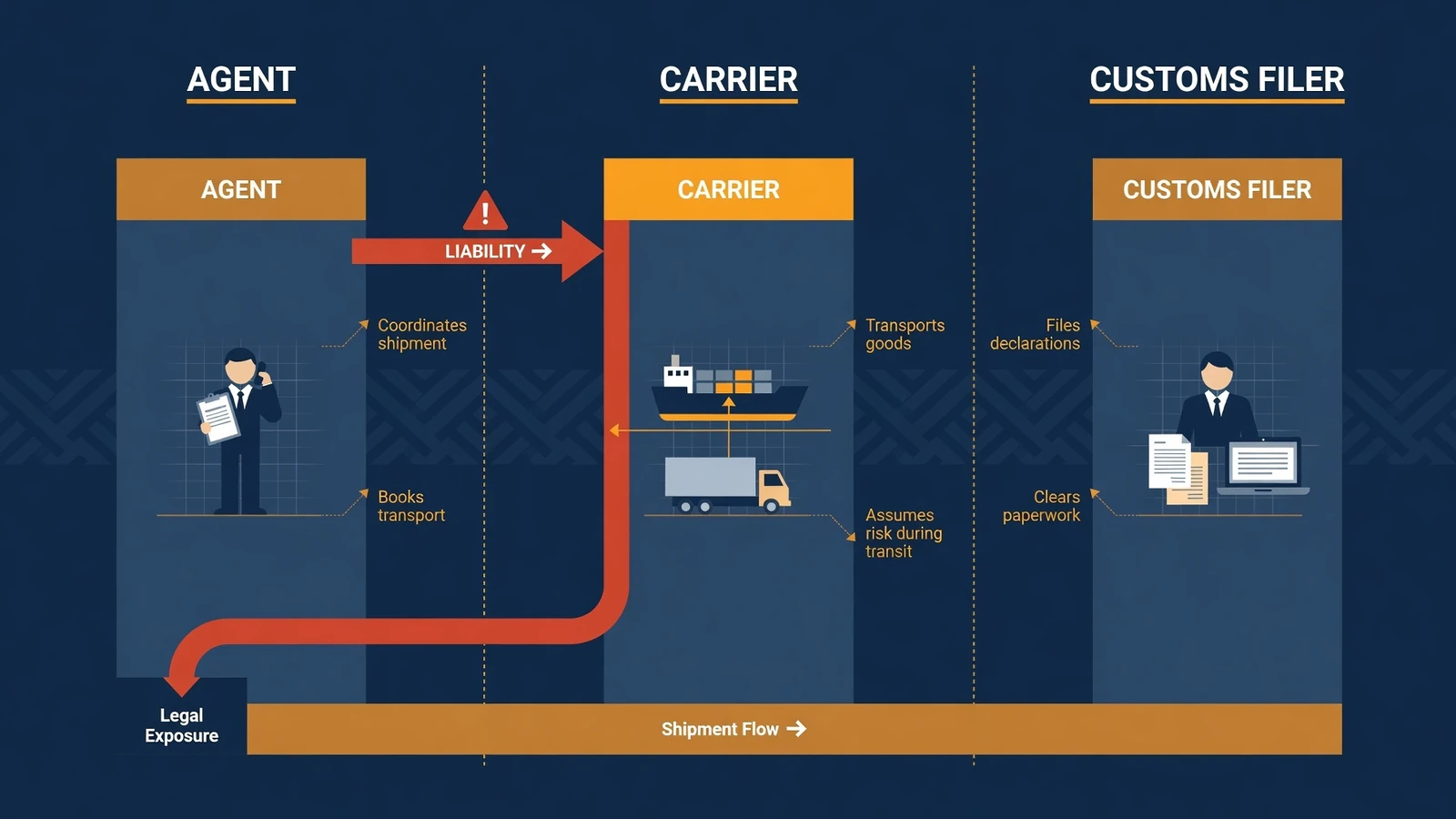
An NVOCC issues its own bill of lading and takes on carrier liability. That single sentence separates the two kinds of Ocean Transportation Intermediary the Federal Maritime Commission licenses, and the distinction decides who you can hold responsible when cargo goes missing.
| Role | Licensed by | Issues a bill of lading | You can hold it liable as |
|---|---|---|---|
| Ocean freight forwarder | FMC | No | Your agent |
| NVOCC | FMC | Yes, its own house B/L | A carrier |
| Customs broker | CBP | No | Your filer |
An ocean freight forwarder arranges carriage and books space in your name. An NVOCC sells you carriage under its own document and then buys it from the vessel operator, which means it carries carrier liability toward you. A customs broker is licensed by US Customs and Border Protection on a separate examination and files your entry; it is not an FMC-licensed intermediary at all.
Both FMC roles can sit under one licence, which is exactly why the registry counts overlap and cannot be summed. Only 6 of 62 pages in this result set mention either role by name.
Customs brokers are the role most often confused with forwarding, because many companies hold both credentials and sell them as one service. Brokerage is a customs function: classification, valuation, entry filing and duty payment. Forwarding is a transport function. A company strong at one is not automatically competent at the other, and asking which licence covers which task is a fair question at the quoting stage. Buyers wanting a single provider should confirm that both credentials exist in the same legal entity rather than in an affiliate.
What is actually checkable before you sign
The FMC list held 3,273 licensed ocean freight forwarder records on 07/26/2026, and a further 9,030 records sit in its NVOCC list. Both are searchable by anyone, free, in about a minute.
| Check | Where | What it proves |
|---|---|---|
| OTI licence number | FMC OTI search | The company may lawfully arrange ocean carriage |
| Trade names | Same record | The brand you were quoted by belongs to that licence |
| Bond on file | Same record | A claim has somewhere to go |
| Published tariff | FMC-1 filing | An NVOCC has met its publication duty |
| USDOT / MC number | FMCSA | The road leg only |
The NVOCC list is mixed, and reading it carelessly produces a wrong number. Registered foreign NVOCCs appear in it without a licence number, so 9,030 is not a count of licensed operators. The two lists also cannot be added together, because a single OTI licence can cover both the forwarding and the NVOCC role and the same company appears in both.
A bond deserves one sentence of realism. The $75,000 an NVOCC posts is a shared pool across all claimants, not insurance for your shipment: if an operator collapses owing sixty customers, everybody recovers cents on the dollar. Forwarders that carry a bond are better screened, not underwritten.
Forwarder pages rarely send readers to the registry: six of the 62 measured mention it at all, and three mention a USDOT number.
A published forwarder tariff is the check most buyers skip. An NVOCC is required to publish its rates, and the location of that publication is something the company can name in one line of an email; a company that cannot say where its tariff lives is either not an NVOCC or is not meeting the obligation. Forwarders acting purely as agents have no such duty, which is itself informative — asking the question sorts the two roles faster than reading a website. The registry record shows which role the licence covers, so the answer is verifiable rather than a matter of trust.
Freight forwarder checks of that kind are already run for the companies this page names, and the results are published as records rather than as opinions: company records read from the federal register carries the licence number, the organization number, the bond on file with its surety and effective date, the qualifying individual and the renewal date for each — every field printed as recorded, or omitted.
Why "cheapest forwarder" is a different question
Forwarder pricing follows the shipment rather than the company: origin, volume and cargo set it. A forwarder quoting a full container from Shanghai and the same forwarder quoting three pallets from Rotterdam are pricing two different businesses, and neither number generalises into a league position.
Cheapness is also unstable in a way size is not. Forwarders buy space from carriers at rates that move weekly, so a provider that was cheapest last month may not be this month, and the ordering reshuffles faster than any page can publish it.
Forwarder quotes can be compared on what they contain, even when the prices cannot. A complete quote names origin and destination charges separately, states whether customs entry and duty are included, and says what happens if the booking rolls. Comparison is possible on completeness even when it is impossible on price, and completeness is visible on the document itself. Importers wanting the arithmetic of the total can work through duty and customs fees on top of the freight.
The spread of forwarder quotes against a public index has not been measured by SeaRates. Four of 62 pages date the price they publish, so the market's own figures cannot be compared across time either.
Whichever forwarder quotes cheapest, destination charges arrive from the same terminals at the same tariff.
Best freight forwarder for a small business, a first-time importer or an ecommerce seller
Forwarder league tables answer one question — who is biggest — and it is rarely the question the reader arrived with. The best freight forwarder for small shipments is not the best one for machinery imports, and an ordering built on revenue cannot tell the two apart. Five buyer profiles recur across these queries, and a different check decides each one:
| Buyer profile | The check that decides it | What the market publishes |
|---|---|---|
| Small business, a few containers a year | whether the quote names destination charges before booking, and who pays when the box rolls | the quote document, not any ranking |
| First-time importer | who files the customs entry, and whose bond stands behind it | 11 of 245 pages in the licence cluster mention Importer Security Filing |
| Ecommerce seller delivering into Amazon | fulfilment-centre appointment capacity and first-window acceptance | 0 of 9 FBA forwarder pages publish it |
| Shipper with less than a container | the 13-15 CBM crossover where LCL stops beating a full container | 0 of 23 LCL consolidator pages publish a method |
| Machinery and out-of-gauge cargo | breakbulk capability and lifting equipment at both ends | not measured by SeaRates |
Freight forwarders sell the same three products — space, paperwork and clearance — to all five, which is why the profile decides the outcome more often than the provider name does. A forwarder strong on full containers out of Shanghai is an ordinary choice for three pallets out of Rotterdam, and revenue rank reports neither case.
Freight forwarding for machinery and project cargo is the profile SeaRates has not measured at all: no corpus was read for breakbulk or out-of-gauge queries, and no lifting or stowage figure appears anywhere on this site. Naming the check and stopping is the honest end of that sentence, because the alternative is recommending from the same revenue table everyone else uses.
Forwarders worth a shortlist answer their profile's question in writing on the first call, and the answer is checkable the same day: the destination-charge list, the name of the entry filer, the appointment window, the CBM at which the quote flips to a container. A provider that cannot put those in an email has not lost on price.
Flexport alternatives, Freightos alternatives: what to compare when you replace a forwarder
Freight forwarder replacement queries name two companies more often than any others in this corpus, and neither name is the answer to them. Flexport recurs in 17 of the 28 queries SeaRates measured on the China to USA trade and across 18 mentions in the 22 Amazon FBA queries; Freightos recurs in 13 of the same 28. Frequency of that kind measures publishing reach, and a replacement is not decided on reach.
Forwarders and platforms are not the same product, and the two names sit in different categories. Freightos sells through a marketplace and also publishes the Freightos Baltic Index — FBX01 read $7,067 per FEU for the week ending 07/17/2026 — so a booking made through a platform can rest with a carrier or a forwarder behind it, and the entity issuing the bill of lading is the one a claim runs against. Flexport does not appear in the Armstrong & Associates 2025 ocean TEU table reproduced above; that is a statement about the list, not about the company, and it is exactly why a revenue table is a poor tool for choosing a replacement.
Five checks decide a switch, and every one of them is answerable before a booking moves:
- The role on the paperwork. Ask who issues the bill of lading. An agent, a carrier and a marketplace put three different names on it, and only one of them takes carrier liability toward you.
- The registry entry under the invoicing entity. Match the name on the quote against the OTI record, not against the brand on the website. One licence can cover both roles, and a trade name can differ from the licensed entity.
- Destination charges named before booking. The line that most often makes a replacement look cheaper is the one nobody quoted. A complete quote states origin and destination charges separately and says what happens when the booking rolls.
- Fit to the profile rather than to the brand. The five buyer profiles above decide more than the provider name: small shipments turn on the CBM crossover, FBA turns on appointment capacity, machinery turns on lifting gear.
- What breaks on the switch. Rate history, contracted allocation and the continuity of whoever files the entry all reset when the provider changes, and the reset costs more than the rate difference in the first quarter.
Freight forwarding comparisons on this page carry no score for either company, and that is a limit rather than an omission: SeaRates has pulled no registry record for them and holds no quote array on their lanes. Three of the 62 pages ranking here publish any method at all, so a scored recommendation assembled today would be indistinguishable from the ones this page criticises.
How to tell a real forwarder from a storefront
A licence number absent from the FMC registry ends the conversation. Fraud in this market does not usually involve forged documents; it involves a website, a bank account and a plausible email, and it collapses on a search that takes a minute. Of 62 pages ranking for these queries, 2 cite a primary source a reader could check.
Working through the checks in order:
- Ask which legal entity issues the bill of lading, not which forwarder brand sells the service.
- Search that entity in the FMC OTI application by company name and by trade name — operators trade under names that differ from the licence.
- Match the address and the officers against what the website claims.
- Ask for the tariff location if the company presents itself as an NVOCC.
- Refuse deposits to personal accounts, and refuse any account in a third country not explained by the routing.
Licence status of the forwarders named on this page has not been verified by SeaRates. The check is open to any reader and takes the same minute for anyone, which is why the procedure is published here rather than a verdict. Readers who want the full walkthrough can check whether the company holds an FMC OTI licence. Per-company profiles carrying bond level and rating history are not published yet, and the register answers the licence half of that question today.
Do you need a forwarder at all?
Booking direct with a carrier removes the forwarder margin and adds every task it covered. Ocean carriers sell space to shippers directly, and a company moving predictable full containers on one lane can often book without an intermediary and pay less.
What disappears with the intermediary is the work, not the requirement. Somebody still files the customs entry, arranges the trucking at both ends, chases the release, handles the rolled booking and answers when the terminal issues a hold. A shipper going direct takes those tasks in-house or buys them separately. None of the 62 pages measured on 07/26/2026 states when that switch is worth making.
Forwarders earn their place on volume and predictability rather than on the size of the shipper. Shippers with a handful of containers a year on shifting lanes usually buy the coordination; shippers with steady weekly volume on one corridor usually stop paying for it. Forwarders earn their margin on the messy end of that spectrum.
What we measured in this search result
Of 62 pages ranking here, three publish a method and none a sample size. SeaRates read the full text of every competing page across these 54 queries on 07/26/2026 and counted disclosure practices rather than opinions.
| Practice | Pages | Share |
|---|---|---|
| Name companies individually | 17 | 27.4% |
| Mention ranking by revenue or volume | 8 | 12.9% |
| Mention the FMC or an OTI licence | 6 | 9.7% |
| Mention a USDOT number | 3 | 4.8% |
| Publish a ranking method | 3 | 4.8% |
| Name Armstrong & Associates as the source | 3 | 4.8% |
| Date a price they publish | 4 | 6.5% |
| Cite a primary source | 2 | 3.2% |
| Disclose how they make money | 1 | 1.6% |
| Use the word median | 1 | 1.6% |
| State a sample size | 0 | 0.0% |
| Frame the question for a US importer | 0 | 0.0% |
Method: full-text sweep of the pages ranking organically for the cluster, 120-word minimum, single pass on 07/26/2026. A price counts as dated when a date appears within 300 characters of it.
Two zeroes in a table of twelve rows say more than the rest of the page. Nobody publishes the size of the sample behind their ordering, and nobody writes for the reader who typed the query into a US search box.
How we will rank, and why we are not ranking yet
A ranking needs a licence check, a rate series and a complaint record. SeaRates holds the first of those three today and neither of the others, which is why this page carries no score column and no ordering.
| Row | What it measures | Source | Do we hold it |
|---|---|---|---|
| Licence and bond | Legal authority for the ocean leg | FMC OTI registry | Available now |
| Rate series | Where quotes actually land, per lane | Own quote array | No |
| Complaint record | What goes wrong and how often | Regulator filings, verified reports | No |
| Disclosure | Whether compensation is stated | The company's own page | Available now |
Publishing the method before the ranking is the commitment this page makes, and 3 of 62 competitors publish any method at all. The licence row will be published before any score is, because the check is available to readers today and does not wait on data collection.
Three of 62 pages publish any method at all, which is the standard this row is being held to. An honest sequence beats a fast one here. A score assembled from what is convenient — review counts, social followings, how polished a website looks — would rank the best-marketed companies, which is the failure mode the existing lists already demonstrate with revenue.
A forwarder complaint record is the row that will take longest to build, and it is the one most worth having. Regulator filings, court records and verified customer reports each capture a different slice of what goes wrong, none of them is complete on its own, and all of them lag the events they describe. Building that row honestly means publishing the sample size and the date range beside every figure derived from it, so that a reader can see when a low complaint count means a clean operator and when it means a small sample. Freight forwarders with two complaints across four hundred shipments and two complaints across nine are not comparable, and a ranking that hides the denominator is worse than no ranking.
NVOCC operators, and why the label matters
NVOCC companies are the half of the OTI licence that carries liability, and the search result for them is thinner than for any other segment measured here: nine queries, and the URL ranking highest is a Reddit thread. Kuehne+Nagel and DSV are the names that recur, alongside smaller operators such as 1 Trade Fwdng and Primary Freight Services.
An NVOCC label decides three things at once. An NVOCC issues its own house bill of lading, so the document you hold names it as carrier; it publishes a tariff; and it posts a $75,000 bond that is a shared pool across all claimants rather than insurance on your consignment. A forwarder holding only the $50,000 forwarder bond cannot issue that document at all, which is the fastest way to tell the two apart on paper.
What makes this segment unusual is that the regulator appears in the search result itself: "the US Federal Maritime Commission" is among the recurring phrases across those nine queries, which happens nowhere else in this project. The registry held 9,030 NVOCC records on 07/26/2026, mixing licensed US operators with registered foreign ones that hold no licence — so the licence column, not the row count, is what answers whether a company may issue a bill of lading into the United States.
Where the two roles diverge in practice — who owes you what when the cargo is damaged — is set out in is an NVOCC the same as a freight forwarder, with the bond category attached to each.
How we make money
Forwarder comparison pages rarely say who pays for them: one of 62 in this result set does. SeaRates is paid nothing by any company in this list — no page here carries a referral link — and rank is never sold. A company cannot buy a position, a badge or a removal of a negative finding.
Disclosure sits at 1 of 62 pages in this result set. Compensation is therefore shown as a column beside providers rather than as a line in the footer, because a disclosure a reader does not see is not a disclosure. When a ranking does appear on this page, the fee column will appear beside it.
What goes wrong with a forwarder
Cargo held by a forwarder against an unpaid invoice is the failure mode league tables omit. Freight forwarders hold a lien over goods in their possession, and a disputed charge becomes leverage the moment the container lands. Forwarder disputes therefore start with the cargo already in somebody else's hands.
Four patterns account for most of the damage:
- The second forwarder invoice. Destination charges excluded from the quote arrive after delivery, and the total lands 30-60% above the booked figure. Ask for origin and destination charges as separate lines before booking.
- DDP on an understated declaration. A quote that looks impossibly good often assumes a declared value below the real one; the importer of record carries that customs risk, not the forwarder.
- The rolled booking. Space is oversold, the container waits for the next sailing, and a standard contract owes nothing for the delay.
- The held container. A dispute over any line in the invoice can stop the release, and demurrage accrues while it is argued. None of the 62 pages measured on 07/26/2026 names a single one of these four patterns. The clock mechanics are the same as on any import — see how the demurrage and detention clock runs.
Buyers comparing providers on a specific trade should look at the lane pages instead of the global lists: how forwarders on the China to USA trade compare covers the busiest corridor, while our ranking for Amazon FBA sellers, who consolidates less-than-container loads into the USA and how NVOCCs differ from forwarders and from carriers cover the qualified segments.
Sources
- Armstrong & Associates, A&A's Top 25 Global Freight Forwarders List — 2026, ranked by 2025 gross logistics revenue and forwarding volumes. Read 07/26/2026.
- Armstrong & Associates, A&A's Top 25 Global Ocean Freight Forwarders List — 2026, ranked by 2025 ocean TEUs; publisher's footnote states figures are company-reported or A&A estimates. Read 07/26/2026.
- Transport Topics, Top Ocean Freight Forwarders 2025 and 2026, ranked by containers in 20-foot equivalent units worldwide. Read 07/26/2026.
- Federal Maritime Commission, OTI search application — 3,273 licensed ocean freight forwarder records and 9,030 NVOCC records. Read 07/26/2026.
- SeaRates measurement of 62 pages across 54 cluster queries, 07/26/2026. Full-text sweep, 120-word minimum; a price counts as dated when a date appears within 300 characters of it.
Corrections to any figure on this page: [email protected].
Frequently asked questions
By 2025 ocean TEUs, Armstrong & Associates lists Sinotrans, Kuehne+Nagel, DSV, DHL, Cosco Shipping Logistics, Ningbo Port Southeast, Nippon Express, CEVA, LX Pantos and C.H. DSV reported the highest revenue at $37,379M for 2025; Sinotrans moved the most ocean containers at 4,925,154 TEUs. Both figures come from Armstrong & Associates' 2026 lists.
Who are the top 10 freight forwarders?
By 2025 ocean TEUs, Armstrong & Associates lists Sinotrans, Kuehne+Nagel, DSV, DHL, Cosco Shipping Logistics, Ningbo Port Southeast, Nippon Express, CEVA, LX Pantos and C.H. Robinson. By gross revenue the order changes, because the two lists measure different things.
Who is the largest freight forwarder?
It depends on the metric, and the same publisher gives two answers. DSV reported the highest revenue at $37,379M for 2025; Sinotrans moved the most ocean containers at 4,925,154 TEUs. Both figures come from Armstrong & Associates' 2026 lists.
Who is the cheapest freight forwarder?
No general answer exists. Price follows the origin, destination, volume and cargo type of a specific shipment, and forwarders buy carrier space at rates that move weekly. Compare quote completeness instead, and ask for origin and destination charges as separate lines.
How do I know if a freight forwarder is legit?
Ask which legal entity issues the bill of lading, then search that entity in the FMC Ocean Transportation Intermediary application by company name and by trade name. A licence number that does not appear in the registry ends the conversation.
What freight forwarders are in the US?
Two US-headquartered companies appear in the top ten of Armstrong's 2026 ocean list: C.H. Robinson at 1,256,000 TEUs, tenth, and Expeditors outside it at 855,200. Most forwarders serving US importers are smaller than anything a global league table lists.
Are freight forwarders worth it?
For irregular volume on shifting lanes, usually yes: the coordination has to happen and somebody has to own it. For steady weekly volume on one corridor, booking direct removes a margin — along with the entry filing, drayage, release chasing and exception handling the forwarder was doing.