Market audit31 ranking pages read · who files the entry on DDP
What the China to USA forwarder lists are based on, and what an importer can check instead
China to USA freight forwarder rankings return zero on the three counts that would make a ranking checkable, and the checks an importer can run instead are all free. What the sweep of 31 pages found:
- Three counts on these freight forwarder rankings came back at zero. 0 pages of the 31 show a score, 0 pages publish a method and 0 pages report a sample size, while 27 pages name companies individually.
- Prices are quoted and rarely dated. 18 pages of the 31 quote a price and 6 pages say when it was true.
- DDP is the product being sold and the one nobody explains. 13 pages of the 31 sell delivered duty paid, and the question it turns on — who is named importer of record on the entry — is answered on almost none of them.
- The bond is sized on the year behind. A continuous customs bond runs at 10% of the previous 12 months' duties, taxes and fees, rounded up to the nearest $10,000 with a $50,000 minimum, so a tariff rise this year leaves it short and cargo stops until it is raised.
- The US credential goes unnamed. 2 pages of the 31 say a forwarder is FMC-licensed, none prints the number, and 0 pages check a company against the registry, which held 3,273 forwarder records and 9,030 NVOCC records on 07/26/2026.
- SeaRates publishes no ranking here either, and says so with the same three zeroes rather than filling the gap with a score of its own.
What the China to USA freight forwarder rankings are built on
China to USA freight forwarder rankings are built on nothing a reader can inspect. Of 31 pages ranking for these queries, 27 name companies individually, 18 quote a price and 6 date it — and not one publishes a score, a weighting or a sample size.
| What the page does | Pages | Share |
|---|---|---|
| Names companies individually | 27 | 87.1% |
| Quotes a price | 18 | 58.1% |
| Dates that price | 6 | 19.4% |
| Shows a score | 0 | 0.0% |
| Publishes a method | 0 | 0.0% |
| Reports a sample size | 0 | 0.0% |
| Says a forwarder is FMC-licensed | 2 | 6.5% |
| Prints the FMC licence number | 0 | 0.0% |
| Checks a company against a registry | 0 | 0.0% |
Freight forwarders on this trade are ordered by whoever wrote the page, and the order is stable across the corpus because the same names recur: Flexport in 17 of 28 queries, AEB Logistics in 16, Sinotrans in 16, Unicargo in 14, Freightos in 13, Kuehne+Nagel in 12 and Expeditors in 10.
Naming frequency is not a freight forwarder score. A forwarder appears often because it publishes content on the lane, and content volume is not a property of the shipment you are about to book. The general-case scorecard sits under what the forwarder league tables measure, built from 62 ranking pages of which 3 publish a method.
Freight forwarders named most often across the 28 queries, with the register check that 0 of the 31 pages perform, run on 07/28/2026:
| Company | Named in 28 query highlights | What the FMC register shows |
|---|---|---|
| Flexport | 17 | FLEXPORT INTERNATIONAL LLC, OTI licence 025219, both roles, $75,000 NVOCC and $50,000 forwarder bonds, renewal 30.09.2026 |
| AEB Logistics | 16 | No entity of that name appears in either federal list. The register covers ocean intermediaries, so this is a finding only if the company arranges the ocean leg itself |
| Sinotrans | 16 | Four Sinotrans entities are in the NVOCC list — Eastern, Guangdong, Limited and South China Container Logistics — all registered foreign NVOCCs based in China, none a US-licensed entity, each bonded at the $150,000 foreign rate rather than the $75,000 licensed one |
| Unicargo | 14 | UNICARGO SUPPLY CHAIN SOLUTIONS, INC. of Bordentown NJ, licence 033596, both roles, bonds $75,000 and $50,000 with American Alternative Insurance since 01.08.2024, renewal 30.06.2028 |
| Freightos | 13 | No entity of that name appears in either federal list. The register covers ocean intermediaries, so this is a finding only if the company arranges the ocean leg itself |
| Kuehne+Nagel | 12 | KUEHNE + NAGEL INC., OTI licence 001162, both roles, $75,000 NVOCC and $50,000 forwarder bonds, renewal 28.02.2027 |
| Expeditors | 10 | EXPEDITORS INTERNATIONAL OF WASHINGTON, INC., OTI licence 002268, both roles, $75,000 NVOCC and $50,000 forwarder bonds, renewal 31.08.2027 |
Three of the seven forwarders carry a US licence that can be read in a public register in under a minute, which is three more checks than the corpus performs in 31 pages. The four blank rows are blank because SeaRates has not looked them up yet, and a blank row is not a finding about the company in it.
DDP is the product being sold, and the one nobody explains
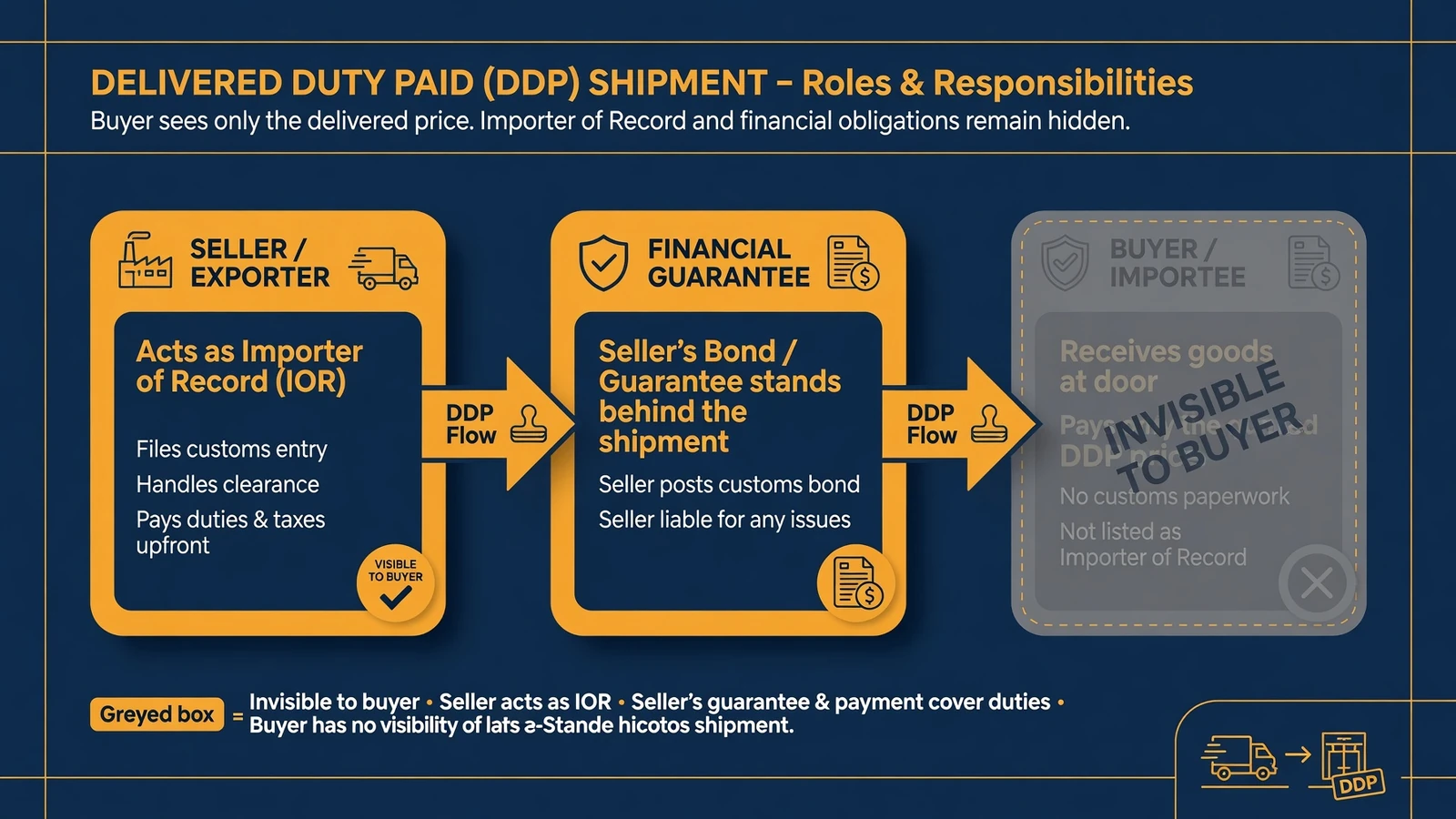
Thirteen of 31 pages sell DDP — delivered duty paid — and the same corpus explains what it means for the buyer on almost none of them. Under DDP, the seller or its forwarder handles export, ocean carriage, the US entry and delivery, and quotes one all-in number per kilo or per container.
The question that decides an importer's exposure is who is named as importer of record on the entry. If it is the forwarder or a party arranged by the seller, the US buyer never sees the declared value, the HTS code or the duty actually paid, and the compliance record sits with somebody else.
Pages in this cluster describe how cheap DDP is produced: declared values marked below the real ones, HTS codes chosen for a lower rate, goods claimed under the de minimis threshold when they do not qualify, and shipments sent without a full customs file. One source in the corpus states plainly that those practices amount to smuggling whatever the supplier believes.
Freight forwarders quoting an all-in DDP rate below the duty alone are not offering efficiency; they are offering a declaration you cannot see. Asking for the entry number after clearance, and checking it, is the whole defence. Sellers shipping into Amazon warehouses meet the same DDP question with an extra party attached: which forwarders handle FBA prep and appointments reads the 9 pages ranking for it.
A DDP quote moves four things from the buyer to somebody else, and the buyer keeps one of them:
| What DDP moves | Who holds it under DDP | What the US buyer still carries |
|---|---|---|
| Export handling and ocean carriage | The seller or its forwarder | Nothing |
| The US entry and the duty payment | Whoever is named importer of record | Exposure, if that party names the buyer |
| The declared value and the HTS code | The filer, unseen by the buyer | Liability for a declaration it never read |
| Delivery to the door | The seller's forwarder | Nothing |
Cheap DDP is produced by four practices this corpus describes openly: declared values marked below the real ones, HTS codes chosen for a lower rate, goods claimed under the de minimis threshold when they do not qualify, and shipments sent without a full customs file. One source in the corpus states plainly that these amount to smuggling whatever the supplier believes.
A DDP price is also not a statement about the service mode. Door-to-door describes where the truck stops; DDP describes who pays the duty, and a quote can be one without being the other. Asking for the entry number after clearance settles both questions at once, because the entry names the importer of record and carries the value that was declared.
Tariffs move faster than the bond behind them
Freight forwarders on the lane mention tariffs, Section 301 or the de minimis threshold on 14 of the 31 pages, which makes it the most-covered compliance topic here and still a minority of the corpus. The number that changes quietly is not the duty rate but the customs bond.
A continuous bond is sized at 10% of the duties, taxes and fees paid over the previous 12 months, rounded up to the nearest $10,000 with a $50,000 minimum. Sufficiency is therefore calculated on last year's payments — so a tariff increase this year leaves the bond short, CBP issues an insufficiency notice, and cargo stops until the bond is raised.
China to USA freight forwarder rankings do not check this, and no importer should assume the forwarder is watching it either. The bond belongs to the importer of record, which loops back to the previous section: if you are not the importer of record, you do not control the instrument your goods are released against. Once the box lands, the charge that accrues fastest is the terminal clock: how the demurrage and detention clock runs sets out the 3 to 7 free days and what day eight costs.
A freight forwarder's rate is the visible half of that bill and rarely the larger one: why shipping from China costs what it does separates the ocean line from the surcharges, the federal fees and the duty.
The mismatch that catches importers is a timing one, and it fits in four lines:
| How the customs bond works | |
|---|---|
| Sized at | 10% of duties, taxes and fees paid over the previous 12 months |
| Rounded | Up to the nearest $10,000, with a $50,000 minimum |
| Measured on | Last year's payments, not this year's rates |
| What happens when a tariff rises | The bond falls short, CBP issues an insufficiency notice, and cargo stops until it is raised |
The bond belongs to the importer of record, which is why the two sections of this page are one question: an importer who is not the importer of record does not control the bond its goods are released against.
The filing that has to happen before the ship sails
China to USA freight forwarder rankings skip the filing that decides whether the container loads at all: Importer Security Filing, ISF-10, has applied to US-bound ocean cargo since 26 January 2009, and a late or missing filing brings penalties, examination and delay. US compliance was counted on this corpus by two topics, not by all of them: tariffs with Section 301 and the de minimis threshold, on 14 of the 31 pages, and the FMC licence behind the ocean leg, on 2 — neither of which prints the number. ISF itself was not counted, so the corpus is silent on how many of the 31 name it. It is filed before the container is loaded at origin, not on arrival.
Freight forwarders on this lane split the work in a way that decides who is accountable: the Chinese office books the vessel, the US office or a customs broker files ISF and the entry. A forwarder that cannot say which entity performs the US filings has not organised the shipment; it has sold the ocean leg and left the rest.
Importers should ask three questions before booking, and each has a documentary answer that no ranking contains:
| Question | Who answers it | Where the answer lives |
|---|---|---|
| Which entity files ISF? | Your forwarder's US arm or broker | ISF confirmation, filed before loading |
| Which entity files the entry? | The customs broker | CBP entry summary |
| Who is importer of record? | The party on the entry | The entry itself, checkable after clearance |
Who is licensed for the US side
China to USA freight forwarder rankings name a US credential exactly once across 31 pages. Chinese forwarders are not licensed by the United States, and they do not have to be — but the party arranging ocean carriage into the US does, if it is issuing a bill of lading or acting as an intermediary there.
| Role | Licensed by | Issues a bill of lading | What it answers for |
|---|---|---|---|
| Ocean freight forwarder | Federal Maritime Commission | No | Booking and documents as your agent |
| NVOCC | Same commission | Yes, its own house B/L | Carriage, with carrier liability |
| Customs broker | Customs and Border Protection | No | The entry filed for you |
| Chinese origin forwarder | Chinese authorities | Sometimes, via a US partner | Origin handling only |
The federal registry held 3,273 ocean freight forwarder records and 9,030 NVOCC records when SeaRates read it on 07/26/2026, and the second list mixes licensed operators with registered foreign ones. Reading the licence column matters more here than anywhere: the counterparty an importer can actually pursue is the licensed one, and the full procedure is on what the FMC registry says about this company.
What we measured, and how we would rank
Freight forwarders on this lane could be compared on four rows, and SeaRates holds two of them today. The audit above is what the search result contains; the table below is what a ranking would need.
| What a ranking would need | How it is measured | Who can confirm it | Can you check it today? |
|---|---|---|---|
| US credential | Entity present in the federal lists | Public registry | Yes — free, and this page shows how |
| Importer of record on DDP | Name on the CBP entry | The entry itself | Yes — it is your own entry |
| Rate spread | Quotes for identical FCL and lane | Our own quote array | No — nobody publishes this, us included |
| Clearance delay rate | Delays divided by entries | Broker and CBP data | No — no denominator is published |
Rates on this lane move weekly and belong beside their reading date rather than in a ranking. SeaRates does not publish per-lane pages yet; what it does publish is everything that lands on top of the rate, line by line, which is the half of the bill the lane quote never carries.
Zero scores and zero methods across 31 pages is not a gap SeaRates fills by publishing a score of its own. It is the reason this page publishes the checks instead.
Sources
- SeaRates measurement of 31 pages of freight forwarder rankings across 28 cluster queries, 07/26/2026. Full-text sweep, 120-word minimum.
- Company naming frequencies from the highlights of 28 captured search results, read 07/25-26/2026.
- U.S. Customs and Border Protection, Importer Security Filing (ISF-10), in force since 26 January 2009. Inherited from the project fact store.
- Continuous customs bond sizing: 10% of prior-year duties, taxes and fees, rounded to the nearest $10,000, minimum $50,000. Secondary source, inherited from the project fact store.
- Federal Maritime Commission, OTI search application — 3,273 licensed ocean freight forwarder records and 9,030 NVOCC records. Read 07/26/2026.
Corrections to any figure on this page: [email protected].
Frequently asked questions
Importer Security Filing, required for US-bound ocean cargo since 26 January 2009 and filed before loading at origin. Because a continuous bond is sized on last year's duties — 10% of them, rounded up, minimum $50,000 — and a tariff increase leaves it short. No page in this search result answers that with anything checkable, and neither does this one.
Who is the best freight forwarder from China to the USA?
No page in this search result answers that with anything checkable, and neither does this one. The names that recur most are Flexport, AEB Logistics, Sinotrans, Unicargo and Freightos — a frequency count, not a ranking.
Is DDP shipping from China safe?
It is legal and common; the risk is invisibility. If you are not the importer of record you do not see the declared value, the HTS code or the duty paid, and an undervalued entry is your exposure once CBP reviews it. Ask for the entry number and check it.
What is ISF and who files it?
Importer Security Filing, required for US-bound ocean cargo since 26 January 2009 and filed before loading at origin. Usually the customs broker or the US arm of your forwarder files it. Late or missing filings bring penalties and examinations.
Why did my shipment stop over a bond?
Because a continuous bond is sized on last year's duties — 10% of them, rounded up, minimum $50,000 — and a tariff increase leaves it short. CBP issues an insufficiency notice and cargo waits until the bond is raised.
Does a Chinese forwarder need a US licence?
Not for work performed in China. For arranging carriage into the US as an intermediary, or for issuing a bill of lading there, the FMC licence applies — which is why the US partner's name matters more than the origin office's brochure.
How do I compare two China to USA quotes?
Put them in the same unit and the same scope: same Incoterm, same container size, same ports, destination charges listed line by line, and the same answer to who files ISF and the entry. Rates alone are not comparable across different scopes.