GuidePriced by volume · what 60 cents a pound actually pays
How moving a household by sea is priced, and which liability rule covers each leg of the move
An international move by sea is priced on the volume the household goods occupy, and the rule covering them changes twice between the front door and the destination agent. What this market publishes, and what it does not:
- Volume, not weight, is the unit an international move is priced in. A 20-foot container holds about 1,172 cubic feet, roughly a two to three bedroom home. Only 25 of the 67 pages SeaRates measured — 37.3% — price in volume units at all.
- Three liability regimes cover one move. 60 cents per pound on the US road leg, where FMCSA's own example is a 25-pound television paying $15; $500 per package at sea; then local law and the destination agent's contract.
- The destination stretches the bill fourfold. Published bands run $3,000-5,000 to Canada and $4,000-18,000 to Australia and New Zealand, and each regional band spans four to five times its own floor because the inventory is not inside it.
- A non-binding estimate is a projection, not a price. A mover may demand up to 110% of it at delivery, and the balance is still owed afterwards.
- Almost nobody dates a price. 31 of the 67 pages name a dollar figure, 5 say when it was true, 1 reports a sample size, and none uses the word median.
- No median rate and no transit promise appear on this page, because both need a quote array this project has not collected.
What international moving by sea actually sells: a container, a share of one, or air
A shared container is sold by the cubic foot; a sole-use container is sold whole, full or not. Three products carry a household across an ocean, and the choice is made by volume long before it is made by preference.
| Method | Sold as | Published band | Typical wait before sailing |
|---|---|---|---|
| LCL, shared container | Cubic feet or CBM of your inventory | $500-1,200 for 100-200 cubic feet | Until the box fills |
| FCL, sole-use container | The whole box, 20ft or 40ft | $1,300-13,000 for a 20ft, depending on source | Your own loading date |
| Air freight | Chargeable weight | $3,000-10,000 for a small shipment | Days |
Shared container shipping — LCL, or groupage — prices the space each household actually occupies, which makes it the cheapest option for anything under roughly a room of furniture. The trade-off is time: a consolidator waits for other households before the container leaves, and that wait belongs to nobody's published transit figure.
A sole-use container is billed whole whether it is full or half empty, so the arithmetic flips once an inventory approaches container size. Movers describe a 20-foot box as a two to three bedroom home, which is the practical threshold at which paying for the whole container starts costing less per cubic foot than paying for a share.
Air freight sits outside the comparison for most households: it prices on chargeable weight rather than volume, and furniture is the wrong shape for that formula. Households that ship a suitcase-scale inventory by air and buy furniture at the destination end up in a different budget entirely.
Households sending goods without moving themselves have their own routes and rates. Those corridors are not published here yet; what does apply to any of them is the destination side of the bill, itemised under duty and customs fees on top of the freight.
Volume, not weight: the unit an ocean move is priced in
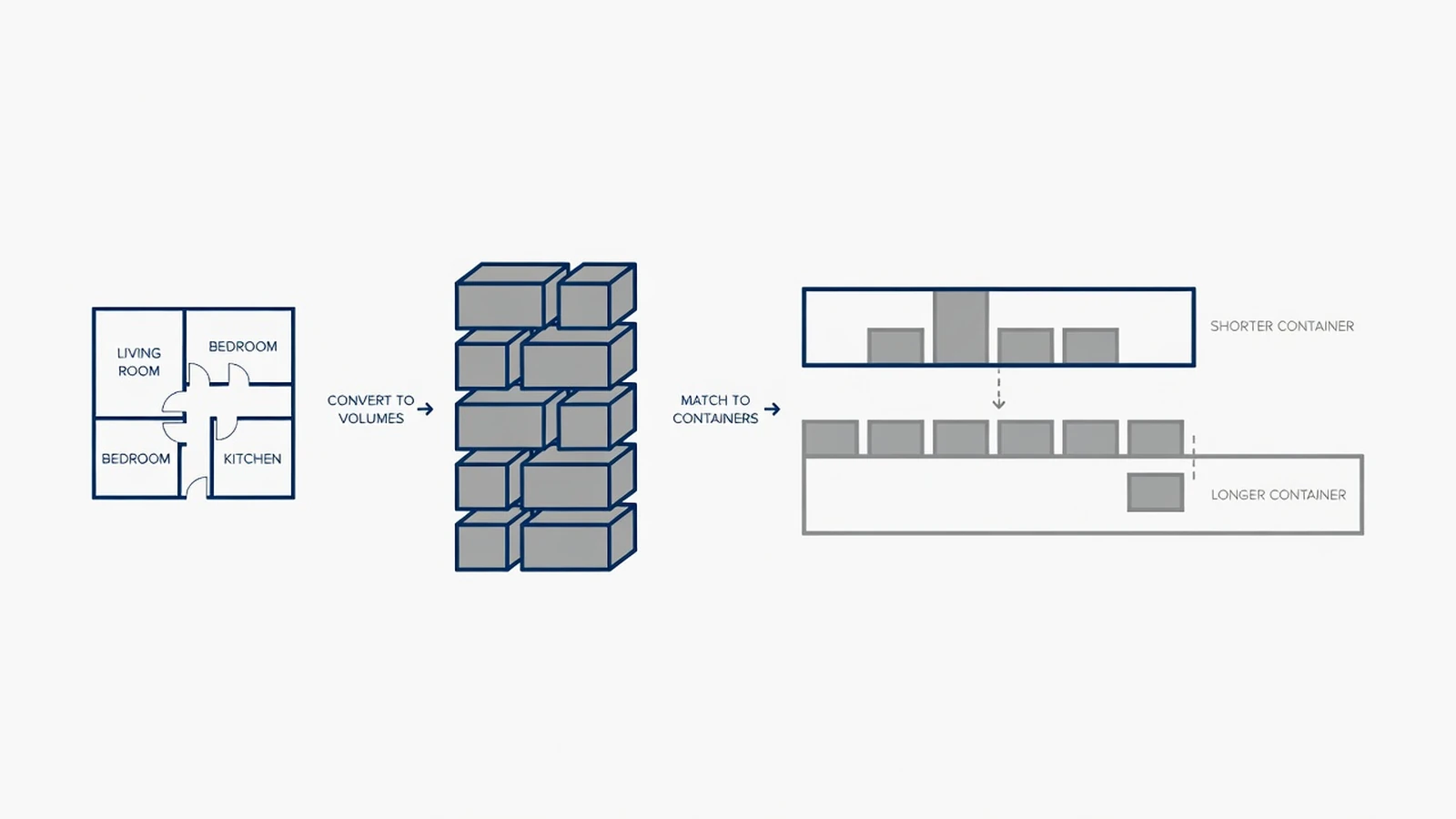
A 20-foot shipping container holds about 1,172 cubic feet of household goods, roughly a two to three bedroom home. Ocean moves are quoted on volume because a ship sells space, and that single fact explains why a mover asks how many rooms you have rather than what your belongings weigh.
| Household | Volume | What it fits |
|---|---|---|
| Studio or one room | 150-300 cubic feet | LCL, a few pallets |
| One to two bedrooms | 400-700 cubic feet | Large LCL or a light 20ft |
| Three bedrooms | 1,000-1,200 cubic feet | A 20ft container |
| Four bedrooms and up | 1,600+ cubic feet | A 40ft container |
Volume as the unit of price for household goods is introduced by 25 of the 67 pages SeaRates measured, 37.3% of the corpus. Moving companies quoting without it are quoting a total, not a rate. The rest quote totals without saying what the total is a price for, which is how two quotes for the same house can look like different services.
Cubic feet convert to cubic metres at roughly 35 to 1, and international movers switch between the units without warning: a US surveyor writes 1,000 cubic feet, a destination agent invoices 28 CBM. Households comparing quotes should convert everything into one unit before comparing anything.
What happens when the surveyed volume of household goods and the loaded volume disagree is explained by 4 of 67 pages — 6.0%. That gap matters more than the headline rate, because a non-binding estimate re-prices on actual volume, and an inventory that grows between the survey and the truck grows the invoice with it.
Weight still appears in this market, but it belongs to the domestic road leg, where interstate movers price by pounds. Asking what an ocean move costs per pound produces a number from the wrong product.
What the published bands come to for a real household, and why the average is the wrong number to plan on, is set out in the average cost of an international move.
Where the household is going stretches the range fourfold
International moving by sea is published at $3,000-5,000 to Canada and $4,000-18,000 to Australia and New Zealand, and both bands describe the same service. Destination is the input that widens every published range, because it decides the ocean leg, the local charges and the customs treatment at once.
| Destination region | Published band | What sits outside it |
|---|---|---|
| Canada | $3,000-5,000 | Duty, destination delivery |
| Europe and the UK | $3,500-17,000 | VAT and clearance, storage |
| Asia and Japan | $3,900-17,500 | Duty, quarantine inspection |
| Australia and New Zealand | $4,000-18,000 | Quarantine and cleaning, duty |
| South America | $3,800-16,000 | Duty, agent fees |
Each regional band for household goods spans four to five times its own floor, which happens because volume is not inside it. Moving companies publishing these bands price the same region differently by a factor of four. A band that stretches from $3,500 to $17,000 is describing a studio and a five-bedroom house in one line, and it can only be narrowed by naming the inventory. Regional pricing of this kind appears in the AI answer Google assembles from a mover's own calculator, and in 0 of the 67 full pages SeaRates captured.
Duty relief on used household goods exists in most markets and is automatic in none: the exemption usually turns on how long the goods were owned, how long the owner lived abroad and how soon after arrival the shipment lands. Duty relief is discussed on 5 of the 67 pages SeaRates measured, 7.5% of the corpus, and none of those five ties it to a destination band. SeaRates has not verified the conditions country by country either, so this page does not state them, and there are no corridor pages to send you to yet. The duty and fee lines themselves, which apply whatever the destination, are itemised under duty and customs fees on top of the freight.
How the move runs from survey to release
The written estimate a mover issues has to sit on an inspection, and a rate quote is not an estimate. Federal rules for interstate moves say so directly, and the same sequence is what a competent international mover follows even where those rules do not reach.
- Survey. In-home or video, listing the household goods the whole price is built on.
- Written estimate. Binding or non-binding, based on that inventory rather than on a phone description.
- Packing and loading. Professional packing changes both the volume and the claim position later.
- Consolidation. For LCL, the shipment waits for the container to fill.
- Export documentation and the bill of lading. The document that names the consignee and governs the ocean leg.
- Ocean transit and destination clearance. Handled by an agent you did not choose and probably will not meet.
- Delivery and unpacking. Against the inventory list produced in step one.
The survey lists the household goods the whole price is built on, and 12 of 67 pages mention a pre-move survey at all. A quote given over the phone without one is a rate quote, and a rate quote re-prices at loading.
Consolidation is where the two big waits live. A shared container leaves when it fills, and destination clearance runs on the local customs queue, so the two ends of the chain add weeks that the ocean schedule never shows.

Sixty cents a pound: what released value actually pays
International moving by sea starts on a truck, and the liability rule that covers that truck is the one every household reads first: federal law requires interstate movers to offer two valuation options, and the free one pays 60 cents per pound. FMCSA's own example is a 25-pound television paying out $15, whatever the television cost.
| Option | What it pays | Cost | Catch |
|---|---|---|---|
| Released Value | 60 cents per pound per article | Free | A 25 lb TV pays $15 |
| Full Value Protection | Repair, replacement or cash settlement | Set by the mover, deductibles apply | Items over $100/lb need listing |
| Marine cargo insurance | Declared value, subject to policy terms | About 1% of declared value | Separate contract, separate insurer |
Released Value limits the mover to 60 cents per pound per article, and choosing it requires a specific signature on the bill of lading or the contract. Without that signature the shipment travels under Full Value Protection automatically, which is the opposite of what most households assume when they sign quickly.
Items worth more than $100 per pound count as extraordinary value — jewellery, china, furs — and the mover may cap liability on them unless they are listed in the shipping documents. Listing them is free and takes minutes; not listing them removes the protection people most want.
A written claim is due within nine months of delivery on an interstate move, and several ordinary actions quietly reduce what a claim can recover: packing your own boxes, putting hazardous or perishable items in the load without telling the mover, and signing a delivery receipt containing language that releases the carrier. That last one is worth striking out by hand before signing.
Thirteen of 67 pages in the SeaRates corpus quote the 60-cent figure, and none of them says where it stops applying. The stopping point is the subject of the tenth section on this page.

Van line, international mover, forwarder, NVOCC: who signs what
An NVOCC moving household goods issues its own bill of lading and takes carrier liability with it. Four kinds of company appear in an overseas move, and 44 of 67 pages name companies without explaining which kind they are naming.
| Role | Licensed by | Document it issues | What it owes you |
|---|---|---|---|
| Van line or agent | FMCSA for the US road leg | Order for service, domestic B/L | The truck leg, under valuation rules |
| International moving company | Varies; often an FMC-licensed OTI | House bill of lading, if licensed | The scope written into the contract |
| Ocean freight forwarder | FMC | None; books in your name | Agency duties |
| NVOCC | FMC | Its own house bill of lading | Carrier liability, subject to COGSA |
A USDOT number held by a moving company covers the truck leg inside the USA and says nothing about the ocean leg. Movers holding one are often entirely legitimate at what it covers, and the number tells a household nothing about who is responsible once the container leaves the port.
Moving companies with an FMC licence carry a bond, and the $75,000 NVOCC bond is a shared pool across all claimants rather than insurance on one household. When an operator fails owing money to dozens of customers at once, that pool divides among them.
Industry accreditation appears rarely: FIDI and FAIM show up on 4 of the 67 pages SeaRates read, a figure an earlier SeaRates count had put at zero. Accreditation audits process and finances rather than price, and it is one of the few signals in this market that is checked by somebody other than the company itself. Comparing the companies themselves is a separate exercise — how international movers compare on our scorecard is where that belongs.
Binding, non-binding and the 110% rule
Under a non-binding estimate a mover may not demand more than 110% of the figure at delivery. Two estimate types exist in the US interstate system, and the difference decides who carries the risk of a wrong volume.
| Estimate | What it guarantees | Payable at delivery | When it changes |
|---|---|---|---|
| Binding | The total will not exceed the estimate | 100% of the estimate | New items or services force a new estimate |
| Non-binding | Nothing; it is a projection | Up to 110%, balance billed later | Actual weight or volume at loading |
A binding estimate from a mover guarantees the delivery bill does not exceed it and is payable in full on delivery. Added items, stairs, an elevator or a parking permit oblige the mover to prepare a new binding estimate rather than to bill the extras onto the old one.
A non-binding estimate re-prices on what was actually loaded, and the 110% ceiling applies only to what can be demanded at delivery: the remainder is billed afterwards and is still owed. Households treating a non-binding number as a price are reading a projection as a promise, and movers rarely correct the reading.
Estimate rules of this kind bind interstate movers, and that qualifier is the one the search results lose. Nineteen of 67 pages ranking for international queries describe a domestic move, and eleven of those nineteen also recite the FMCSA rules — the drift in topic and the drift in law travel together.
How long an overseas move takes, and what the published weeks measure
International moving by sea is published at three to five weeks on the water and eight to twelve door to door, and the gap between those two figures is the shore side. Published transit figures measure different things, and reading two of them as the same number is how a delivery date gets promised to a landlord.
Four intervals stack up for household goods. Packing and pickup take days. Consolidation for a shared container takes as long as the container takes to fill. Ocean transit is the only stretch with a schedule behind it. Destination clearance and delivery depend on the local customs queue and on whether the paperwork was right the first time.
Twelve of 67 pages in the SeaRates sweep quote a transit figure, 17.9%, and none reports the shipments behind it. A number without a sample cannot be distinguished from a marketing average, however plausible it looks.
SeaRates has not measured a median transit for household goods corridors, so no vendor week count is repeated here as fact. Households needing a date should ask which vessel and voyage the booking is against and what the destination agent's current clearance time is — both are answerable, and neither appears in a published range.
The four intervals, and which of them the published figures actually cover:
| Interval | What sets its length | What the published weeks measure |
|---|---|---|
| Packing and pickup | Crew scheduling at origin | Outside every published transit figure |
| Consolidation for a shared container | However long the container takes to fill | Belongs to nobody's published figure, and it is the interval households are never warned about |
| Ocean transit | The vessel schedule — the only stretch with one behind it | This is the three to five weeks on the water |
| Destination clearance and delivery | The local customs queue, and whether the paperwork was right the first time | The difference between three to five weeks and eight to twelve door to door |
The table carries no counts of its own beyond the two published spans, because 12 of the 67 pages measured quote a transit figure for an international move and not one reports the shipments behind it. Two ranges that measure different stretches of the same move are not two opinions about the same number.
What the quote leaves for the destination
Duty relief on used household goods exists in most markets and is never automatic. An ocean quote stops at the destination port, and the charges after that arrive from parties the household never selected.
| Line | In the moving quote? | Billed by |
|---|---|---|
| Packing and origin services | Usually | Your mover |
| Ocean freight | Yes | Carrier or NVOCC |
| Marine cargo insurance | Optional, about 1% of declared value | Insurer or broker |
| Destination terminal handling | No | Destination terminal |
| Customs clearance | Sometimes, as an agent fee | Local agent |
| Import duty and taxes | No | Destination customs |
| Storage after free time | No | Terminal or agent |
| Delivery above ground floor, long carry | Rarely | Destination agent |
Destination-side costs of an international move are named by 12 of the 67 pages SeaRates measured, 17.9% of the corpus, which leaves five pages in six quoting a moving price that stops at the port. Marine cover on household goods costs about 1% of declared value with a $500 to $1,000 deductible, and it is a separate contract from the mover's valuation coverage. Buying one does not affect the other, and a claim can involve both.
Storage at destination starts when free time runs out, which is the same clock as any other import: demurrage and detention charges explains how it runs and who it is billed to. What the full delivered cost contains, line by line, is set out under duty and customs fees on top of the freight.
Three liability regimes in one move, and the corpus that mixes them up
International moving by sea passes a household through three separate liability regimes, and 15 of the 67 pages in this search result explain the first, 3 explain the second, and none explain both. Goods do not travel under one contract from door to door; they travel under a chain of them.
| Leg | Governing document | Liability ceiling | Where a claim goes |
|---|---|---|---|
| US road leg | Order for service, domestic B/L | 60 cents per pound, or Full Value Protection | The mover, within nine months |
| Ocean leg | Ocean or house bill of lading | $500 per package under COGSA | The carrier or NVOCC named on the B/L |
| Destination leg | Local contract and law | Whatever the destination contract says | The destination agent |
COGSA limits the ocean carrier of household goods to $500 per package, a ceiling in place for nearly a century in a statute that never defines what a package is. Decades of litigation followed, and the practical effect for a household is that the payout depends on how the shipment was described on the bill of lading.
A carrier moving household goods may define package in its own bill of lading, and according to a 04/30/2026 review by the law firm MMWR, a line of Second Circuit decisions has upheld exactly that — a clause defining a package as any palletised or unitised assemblage was enforced in Hercules OEM Group v. Zim Integrated Shipping Services. Under such a clause an entire pallet of belongings can be one package.
Thirteen pages about movers in this corpus quote the 60-cent rule; none of them mentions COGSA. The two sets of pages do not overlap at all — the regime that applies before the port and the regime that applies after it are described by different articles, and a household reading either one comes away with half a picture.
Three practical consequences follow. Ask which document covers each leg and who issues it. Buy marine cargo insurance for the ocean leg rather than assuming valuation coverage extends to it. And record the inventory and its condition at loading, because every one of the three regimes settles claims against that record.
Where the numbers in these calculators come from
International moving by sea is quoted freely in this search result: 31 of the 67 pages name a dollar figure, and 5 of them say when the figure was true. SeaRates read the full text of every page ranking in Google US for these 27 queries on 07/26/2026 and counted what each discloses about its own numbers.
| What the page does | Pages | Share |
|---|---|---|
| Names a dollar figure | 31 | 46.3% |
| States when that figure was true | 5 | 7.5% |
| Uses the word median | 0 | 0.0% |
| Reports a sample size | 1 | 1.5% |
| Prices in volume units | 25 | 37.3% |
| Explains a volume dispute | 3 | 4.5% |
| Mentions any regulator | 24 | 35.8% |
The date count on these mover pages deserves its own note. A first pass flagged 9 pages as dating their prices; reading each one left 6, because in three cases the date beside the sum was the article's publication date or a year belonging to an unrelated figure. Publishing both numbers is more honest than publishing the flattering one.
Two sources price the same 20-foot container of household goods 6.5 times apart: $1,300-2,000 in one rate card against $2,500-13,000 in another, read on the same day. The disagreement between publishers is larger than the difference between a shared container and a sole-use one inside either of them, which tells a household exactly how much planning weight an "average" carries here.
SeaRates has no quote array for household goods moves, so no median appears on this page and no total is implied. The bands quoted in the earlier sections are published vendor ranges read on 07/26/2026, labelled as ranges, and carrying the date they were read. When a quote array exists, the median will replace them with its sample size and cut-off date attached.
Which licence covers the ocean leg, and how to check it
Fifty-two of 67 pages about movers name no regulator at all. USDOT or FMCSA appears on 11 pages against 5 naming FMC — the only corpus in this project where the road regulator genuinely outranks the ocean one — and 0 of 67 check a named company against the FMC registry.
A missing mention is not a missing licence. The sweep counts what pages say, not what companies hold, and many licensed movers simply never write about it. The consequence for a household is still real: with no credential named anywhere, the shortlist collapses onto review scores and website polish.
Three steps settle it before a deposit is paid:
- Ask which legal entity issues the bill of lading for your household goods. Brands and trading names are not licences; the entity on the document is the one a claim goes to.
- Search that entity in the FMC Ocean Transportation Intermediary application, by company name and by trade name. The registry held 3,273 licensed ocean freight forwarder records and 9,030 NVOCC records when SeaRates read it on 07/26/2026, and the NVOCC list mixes licensed operators with registered foreign ones — read the licence column, not the row count.
- Match the credential to the leg. A USDOT or MC number belongs to the truck. A mover showing only those numbers may be arranging the ocean leg through somebody else, and that somebody is who you would be claiming against.
The full licence procedure for movers, including what the bond does and does not guarantee, is set out under how to tell a real ocean licence from a truck one.
Sources
- FMCSA, Liability & Protection (Protect Your Move) — two mandatory valuation options, 60 cents per pound under Released Value, the $100-per-pound extraordinary value threshold, and the nine-month claim window. Page updated 11/04/2024, read 07/26/2026.
- FMCSA, What is a binding move estimate? — written estimate based on actual or virtual inspection, 100% payable under a binding estimate, 110% ceiling under a non-binding one. Read 07/26/2026.
- Montgomery McCracken Walker & Rhoads, Redefining Package Limitation in the United States, 04/30/2026 — COGSA's $500 per package limit and the contractual definition of "package" upheld in Hercules OEM Group v. Zim Integrated Shipping Services (S.D.N.Y. 2023). Secondary source; read 07/26/2026.
- Federal Maritime Commission, OTI search application — 3,273 licensed ocean freight forwarder records and 9,030 NVOCC records. Read 07/26/2026.
- Published vendor ranges for LCL, FCL and air freight and the regional bands, collected from the AI answers and organic results generated for these 27 queries. Read 07/25-26/2026.
- SeaRates measurement of 67 pages across 27 cluster queries, 07/26/2026. Full-text sweep, 120-word minimum; every price-date match was read individually, and 3 of 9 machine matches were rejected as publication dates rather than price dates.
Corrections to any figure on this page: [email protected].
Frequently asked questions
Valuation coverage a mover offers is its own limit of liability under its contract — 60 cents per pound under Released Value, or replacement value under Full Value Protection. Marine cargo insurance is a separate policy from an insurer, priced at about 1% of declared value, and it is what covers the ocean leg. FMCSA's published example uses a 25-pound television and a $15 payout.
Is carrier liability the same as insurance?
No. Valuation coverage a mover offers is its own limit of liability under its contract — 60 cents per pound under Released Value, or replacement value under Full Value Protection. Marine cargo insurance is a separate policy from an insurer, priced at about 1% of declared value, and it is what covers the ocean leg.
What does 60 cents per pound pay on a 50-pound item?
Thirty dollars, regardless of what the item cost. FMCSA's published example uses a 25-pound television and a $15 payout. The rule applies to interstate moves by road; on the ocean leg the governing limit is COGSA's $500 per package.
What is the difference between a binding and non-binding estimate?
A binding estimate from a mover fixes the price and is payable in full at delivery; adding items or services requires a new one. A non-binding estimate re-prices on actual volume or weight, and the mover may not demand more than 110% of it at delivery — the rest is billed afterwards.
How much does an international move by sea cost?
Published bands run $500-1,200 for a small LCL shipment, $1,300-13,000 for a 20-foot container depending on which source you read, and $3,000-18,000 by destination region. Those are vendor ranges read on 07/26/2026, not medians of paid invoices, and none of them includes destination duty.
What items cannot be moved by movers?
Hazardous and flammable goods, perishables, and anything the destination restricts — commonly untreated wood, plants, seeds, some foods and firearms. Packing restricted items without telling the mover also reduces what a claim can recover.
How do I check that an international mover is licensed for the ocean leg?
Ask which entity issues the bill of lading, then search that name in the FMC OTI application. A USDOT number covers US trucking only. None of the 67 pages in this result set performs that check for the companies it recommends.